
Published at : 2026-03-03 04:46:00 | Views: 2,124
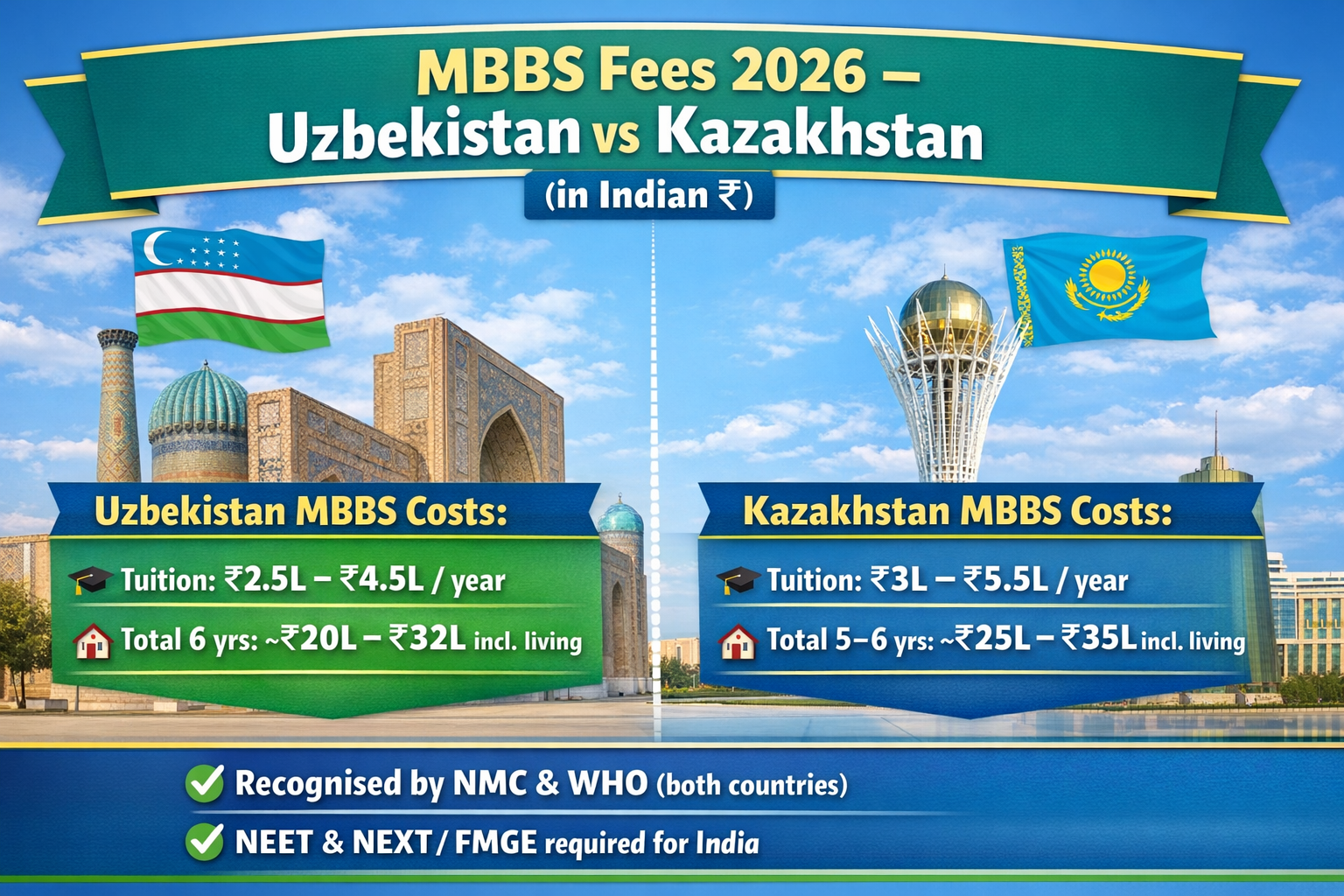
Indian medical aspirants are faced with the tough decision of selecting a country for their medical studies. Since the private medical colleges in India have extremely high tuition fees, students try to search for international medical schools that prove cost-effective. Uzbekistan and Kazakhstan are among the most popular options in Central Asia. This 2026 comparison will cover tuition fees, hostel cost, living expenses and total budget in Indian Rupees (INR).
Tuition Fees Comparison (2026)
In Uzbekistan, the annual tuition fee usually varies between ₹2.5 lakh to ₹4 lakh per annum. Total tuition fee approximately:b-> Since the course duration is 5 to 6 years ( internship included) so total tuition cost equals:
₹15 lakh to ₹22 lakh (entire course)
Thus Mbbs in Uzbekistan is a cheaper and convenient option as the total fee structure of private medical colleges in India can go much beyond maximum fees at ₹70–80 lakh.
In Kazakhstan, the annual fee is a little more, and it usually ranges between:
₹3 lakh to ₹5 lakh per year
The total an entire 5–6 year program may cost in tuition fees:
₹18 lakh to ₹28 lakh
Kazakhstan provides inexpensive education compared to Western life too, but Uzbekistan usually wins in terms of prices.
Hostel fee: ₹60,000 to ₹1,00,000 per annum
Total hostel fees (5–6 years): ₹3 lakh to ₹5 lakh
University hostels mostly come with furnished rooms, internet provision, heating systems and secured premises. Catered hostel accommodation is also a popular option among young Indian men and women because of its safety and cost-effective implications.
Hostel fees: ₹70,000 – ₹1,20,000 per year
Total hostel expenses (5–6 years): ₹3.5 lakh to ₹6 lakh
Accommodation in specimen cities such as Almaty is a touch pricier than most cities in Uzbekistan.
Here are the general living costs in Uzbekistan on a monthly basis:
Food: ₹8,000–₹12,000
Transportation: ₹1,000–₹2,000
Miscellaneous expenses: ₹3,000–₹5,000
Monthly Expenditure: ₹12,000 to ₹18,000
Overall: ₹8 lakh to ₹10 lakh; 5–6 years
Another reason that adds to the attractiveness of Mbbs in Uzbekistan for Indian students is its lower cost of living.
In Kazakhstan monthly cost of living typically are:
₹15,000 to ₹20,000
Overall, over 5–6 years: ₹9 lakh to ₹12 lakh
Kazakhstan: If you fly in from Europe or the USA, Kazakhstan feels relatively cheap, but it is just a bit more expensive than Uzbekistan.
Students In Both Countries Should Also计算 Costs Such As:
Admission & registration fees: ₹50,000–₹1,00,000
Visa processing: ₹15,000–₹25,000
Medical insurance: ₹10,000–₹15,000 per year
Airfare: ₹25,000–₹40,000
Documentation & medical tests: ₹10,000–₹20,000
These additional costs typically account for ₹1.5 lakh to ₹2.5 lakh of the overall budget depending on your expenses.
Tuition: ₹15–22 lakh
Hostel: ₹3–5 lakh
Living: ₹8–10 lakh
Miscellaneous: ₹1.5–2.5 lakh
Approximate Total: ₹28 lakh to ₹40 lakh
Tuition: ₹18–28 lakh
Hostel: ₹3.5–6 lakh
Living: ₹9–12 lakh
Miscellaneous: ₹1.5–2.5 lakh
Approximate Total: ₹32 lakh — ₹48 lakh
If we talk about the financial aspect, Uzbekistan is overall ₹3–8 lakh more affordable as compared to Kazakhstan with respect to course duration.
Indian students need to always ensure that it is following the official guidelines by the National Medical Commission (NMC) before choosing any university. After MBBS abroad, NMC approval to pass FMGE/NExT in India.
Also, check if the university is mentioned in the World Directory of Medical Schools (WDOMS) as this is required for international recognition and to meet eligibility criteria for some countries.
Universities of both Uzbekistan and Kazakhstan are included in WDOMS, but every institution must be verified separately.
For Indian Rupee incl. total expenses comparison:
Tuition fees in Uzbekistan are a little (more) affordable.
Cost of living is relatively lower in Uzbekistan.
The whole course in Uzbekistan costs less than in Kazakhstan.
Thus, Mbbs in Uzbekistan might probably be the most cost-effective option for Indian students on a budget in 2026.
Despite being less expensive than study destinations such as the U.K., students ought to consider clinical exposure, quality of faculty, language of instruction and career prospects before finalizing on a specific country.