
Published at : 2026-08-05 19:03:00 | Views: 2,070
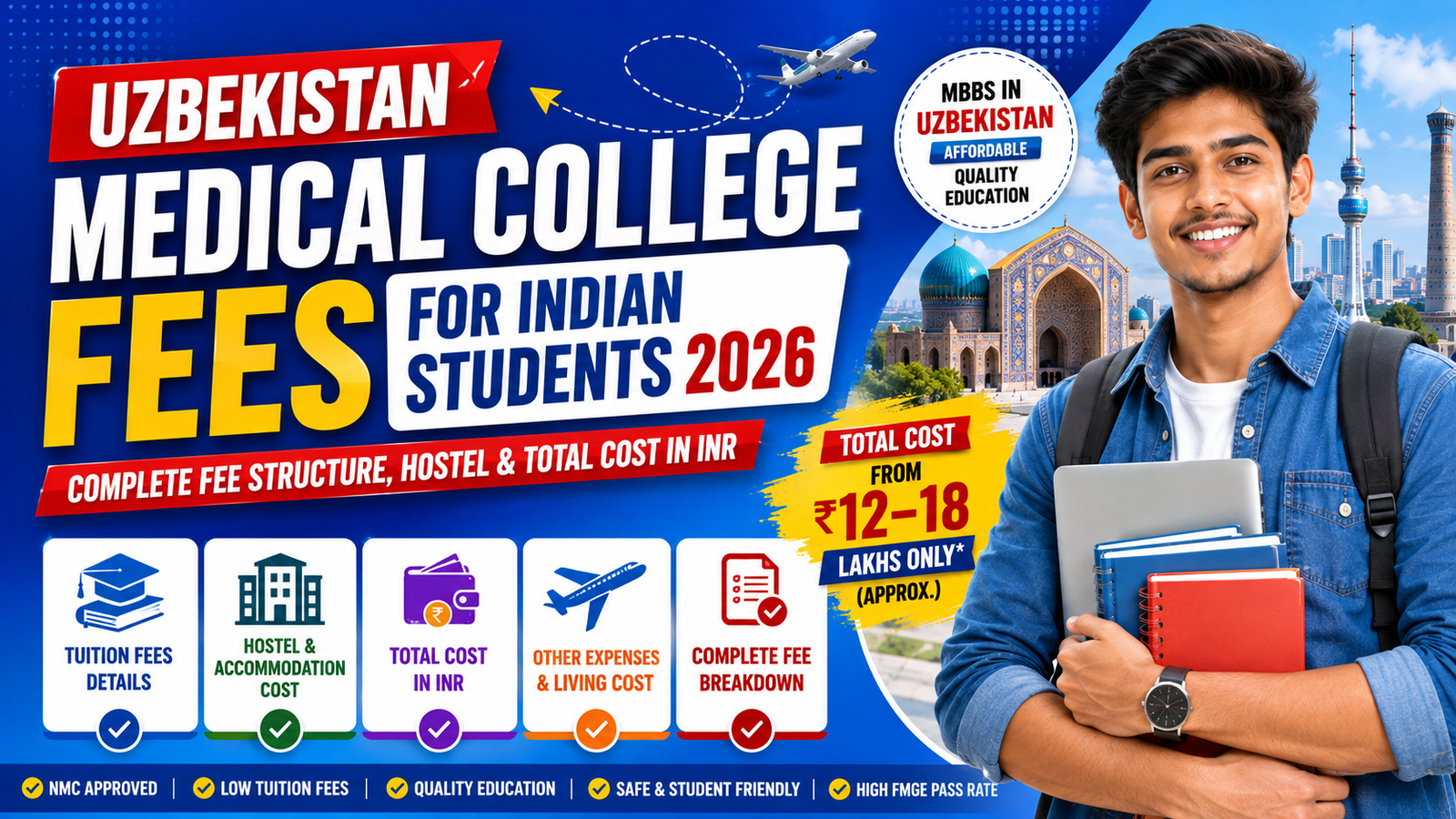
Let me be honest – studying MBBS in Uzbekistan has genuinely proven to be the most affordable option for thousands of Indian students over the years. Think about it: private medical colleges in India have comparably higher fees. But medical colleges in Uzbekistan? They provide quality medical education, English programs, experienced faculties, and teaching hospitals – all at lower costs.
Now, here's what parents and students absolutely need to understand: the complete cost involved goes way beyond just what you see on the university's tuition sheet. Your budget needs to account for the hostel, food, medical insurance, visas, and daily living costs too. It all adds up.
This guide is going to cover the Uzbekistan medical college fees for Indian students, tuition fees, hostel costs, living costs, admissions, eligibility, the pros and cons of studying there, career opportunities, and FAQs for 2026. Everything you need.
So here's the real figure: for the six-year program, MBBS in Uzbekistan is estimated to cost between 22-35 lakhs. Now, this can go higher depending on your choice of university and if you opt for more expensive accommodation. Tuition costs range from USD 3,500 to USD 5,500 annually. The good news? The cost for hostel and living is actually quite affordable for Indian students.
Quality education is affordable in Uzbekistan – that's the real attraction here. Let me break down some advantages of pursuing MBBS in Uzbekistan:
Low tuition costs
MBBS taught entirely in English
Medical teachers with good teaching and learning experience
Well-equipped labs and teaching hospitals
Secure environment for international students
Large and growing Indian community
Simple admission criteria
When students are choosing to study MBBS in Uzbekistan, they naturally compare the cost with the cost of pursuing MBBS in other countries. And honestly, Uzbekistan wins hands down on that comparison.
Before you even think about applying to MBBS universities in Uzbekistan, Indian students must check the below eligibility criteria – no shortcuts here:
First things first: the candidate must have completed 12th standard or equivalent in a recognized Board.
Also, the candidate must have studied Physics, Chemistry, Biology, and English in the 12th standard – these are non-negotiable.
General category students must have a minimum of 50% in PCB. Other students must have a minimum of 40% as per the ruling.
Pretty straightforward: the candidate must be of 17 years or above on the date of admission.
Here's what's critical: Indian students must qualify for the National Eligibility Entrance Test (NEET) to become eligible to pursue MBBS in India as per the latest ruling of the National Medical Commission (NMC).
Alright, so the cost of studying MBBS in Uzbekistan is university dependent – there's no single price tag. Here's what the cost per year looks like in various Medical Universities of Uzbekistan:
MBBS University of Uzbekistan | Cost |
Tashkent Medical Academy | USD 4,000–5,500 |
Samarkand State Medical University | USD 3,800–5,000 |
Bukhara State Medical Institute | USD 3,800–4,800 |
Andijan State Medical Institute | USD 3,500–4,500 |
Fergana Medical Institute of Public Health | USD 3,500–4,500 |
University | INR |
Tashkent Medical Academy | ₹3.4–4.8 lakh |
Samarkand State Medical University | ₹3.2–4.3 lakh |
Bukhara State Medical Institute | ₹3.2–4.1 lakh |
Andijan State Medical Institute | ₹3.0–3.9 lakh |
Fergana Medical Institute of Public Health | ₹3.0–3.9 lakh |
Let me give you a realistic breakdown of what you should actually budget for:
Cost Item | Estimated Cost (INR) |
Tuition Fee | ₹300,000 - ₹480,000 |
Hostel Fee | ₹45,000 - ₹90,000 |
Food Cost | ₹90,000 - ₹140,000 |
Medical Insurance | ₹10,000 - ₹20,000 |
Visa Fee | ₹10,000 - ₹20,000 |
Books | ₹20,000 - ₹40,000 |
Students should definitely estimate their personal and educational expenses while planning for the entire duration of the course. Don't underestimate these – they add up.
Most of the universities have solid provisions for hostel facilities to accommodate international students. Here's what you can typically expect in a hostel:
Rooms with furniture
Wi-Fi connectivity
Heating systems for cold winters
Kitchen (Shared)
Laundry services
Security (CCTV monitoring)
Quiet study (Reading) Rooms
Recreation Rooms for downtime
And good news: separate hostel facilities for male and female students are provided by most of the universities.
Here's what makes Uzbekistan attractive: the cost of living is genuinely affordable when compared to other countries. The expenses that students typically incur are on:
Food
Transport
Internet
Mobile (Communication)
Shopping
Entertainment
Medical expenses
Your lifestyle really does determine the level of expenditure, but it is, by and large, quite economic for students in Uzbekistan.
Look, the admission process here is actually simple and straightforward – which is refreshing. Here's how it works:
Step 1 – Recognition of Medical University (verify it's legitimate)
Step 2 – Submission of Academic Documents
Step 3 – Receive Admission Letter
Step 4 – Payment of Tuition Fees
Step 5 – Apply for Student Visa
Step 6 – Travel to Uzbekistan and University Registration
Pro tip: students should apply well in advance of the commencement of the academic session if they want to Study MBBS in Uzbekistan.
Cost-Effective Medical Education
Medical studies in Uzbekistan are literally at a fraction of the cost of private medical colleges across India. That's the reality.
English-Medium Programs
Most medical universities in Uzbekistan have a full MBBS program taught in English, so language barriers with coursework aren't an issue.
Modern Medical Facilities
Most medical universities have modern medical facilities, and students genuinely have the opportunity of working in a modern medical environment.
Clinical Exposure
You'll get your first real taste of clinical practice a few years into your MBBS, which is super valuable.
International Recognition
A lot of the universities are listed in medical directories like the World Directory of Medical Schools (WDOMS), so your degree carries weight globally.
Safe Student Environment
You'll find that Uzbekistan has a lot of international students, which creates a supportive community. Students looking for an MBBS in Uzbekistan have selected this nation specifically for its lower price education and quality medical training.
But before you jump in, you should honestly learn about the difficulties that come with studying there. Knowledge is power, right?
Language Barrier
A little Russian or Uzbek will genuinely come in handy during clinical practice – especially when dealing with patients.
Climate
Cold winters can be a little difficult to get used to for Indian students who are coming from warmer regions.
Currency Fluctuation
Frequent small changes to the exchange rate can affect the overall cost of your education – this is worth keeping an eye on.
Regulatory Requirements
The NMC's updates will affect international students, and honestly, you should be mindful of this and stay informed.
The exciting part? Your career options will actually be quite expansive once you graduate.
Practice in India
Indian medical graduates have to comply with the Indian NMC regulations, but it's definitely achievable if you've qualified NEET.
Postgraduate Medical Education
You can also pursue postgraduate degrees in India and abroad if you want to specialize further.
International Medical Practice
You can also take the licensing exams in other countries and genuinely get a chance to practice medicine there.
Medical Research
There are also plenty of opportunities in medical research if that's your passion.
Hospital Administration
You can explore opportunities in healthcare management and hospital administration too.
Look, staying within your budget is actually easy for students when they make smart choices:
Opt for the university-hosted accommodation (usually cheaper and convenient)
Share your university-hosted accommodation (splits costs)
Use the public transport system (way cheaper than taxis)
Cook your own food (way more affordable than eating out)
Budget and do a planned currency exchange before your departure (saves money)
Real talk: a good budget and planned exchange means that you will have a stress-free education period.
Here's what I'll tell you straight up: admission and recognition information should be confirmed by students using official resources. Don't rely on hearsay. Check these:
WHO – International healthcare standards
NMC – Indian medical regulations and requirements
WDOMS – University recognition verification
NTA (NEET) – NEET examination details
Uzbekistan Higher Education – Official government portal
MBBS in Uzbekistan – Program-specific information
The total is estimated around ₹22 lakh to ₹35 lakh for the duration of 6 years depending on the different universities and your different lifestyle choices.
These are estimated between USD 3,500 and USD 5,500 across the different universities.
Universities charge hostel fees separately, honestly. Some universities may include hostel fees in the admission packages, but students absolutely have to check all the latest updates on the official website of the respective university.
Yes. As per the latest guidelines of the National Medical Commission, all medical aspirants must qualify for NEET to practice in India.
Absolutely. Other than a few countries, Uzbekistan is genuinely one of the countries with the cheapest stay, food, and transport costs.
Uzbekistan is most affordable with genuinely good medical education for students seeking quality medical training. It will definitely be worth the price for students who want solid medical education without breaking the bank.
The MBBS in Uzbekistan fee structure really does play a key role in why Indian students continue to select the country for medical education in 2026. Uzbekistan offers a genuinely more economical route to earning a medical degree because of its low annual tuition fees – especially when compared to the high costs of private medical colleges in India – as well as affordable boarding and other living costs.
Here's my final advice: check the universities thoroughly and make absolutely sure to check for the latest fees, the official recognitions, and the prevailing regulations of the National Medical Commission before applying. An effective budget and selecting the right university truly serves the purpose of getting an economical medical education.