
Published at : 2026-09-16 06:09:00 | Views: 2,036
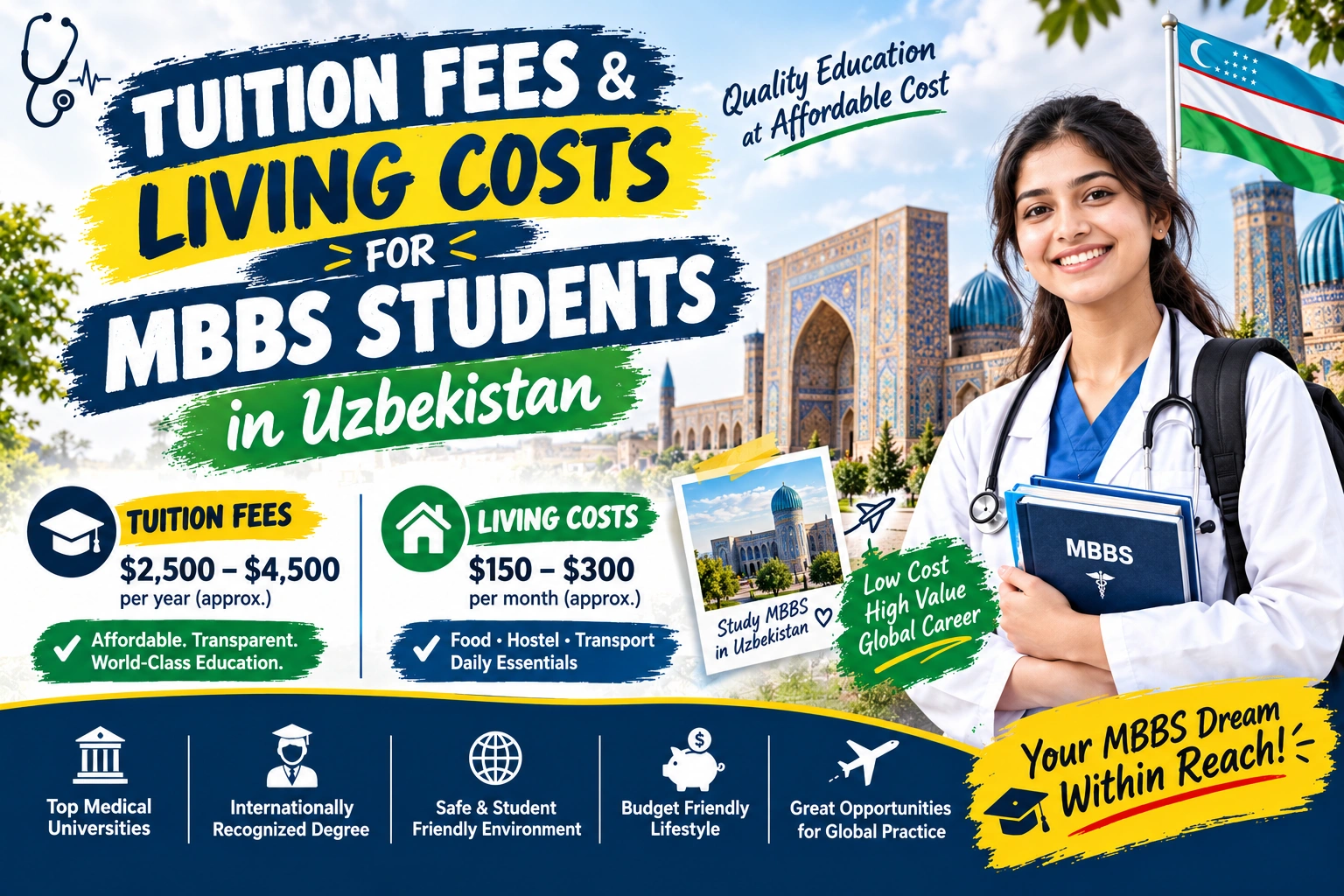
The tuition quotation says USD 3,500 per year. Reasonable. Then the family discovers that hostel charges, mess fees, registration, insurance, visa renewal, flights, winter clothing, and currency-conversion charges weren’t included. Now the budget looks different. For students planning MBBS in Uzbekistan, tuition is only one part of the financial picture. A sensible six-year estimate should cover university fees, accommodation, food, transport, medical insurance, documentation, travel, study resources, and a small emergency reserve. Some expenses occur every month. Others arrive once a year and hurt a little more. Let’s calculate it properly.
Tuition for English-medium medical programmes at many public universities in Uzbekistan may broadly fall between USD 3,000 and USD 5,500 per year. Certain private, international, or specially structured programmes can cost more. In Indian currency, that may work out to roughly ₹2.7–5 lakh annually, depending on the exchange rate at the time of payment. Currency matters. A fee fixed in US dollars can become more expensive in rupees even if the university doesn’t increase its official charge.
Students should request an official fee letter containing:
Tuition for every academic year
Currency in which payment must be made
Payment deadline
Semester-wise or annual payment option
Bank and transfer charges
Late-payment penalty
Refund and withdrawal policy
Conditions allowing fee revision
Don’t calculate the full course by multiplying the first-year fee by six until the university confirms whether later-year tuition remains the same.
Here’s the honest part: online fees for the same university often differ. One website may include hostel and food, another may quote tuition only, while a third may still display an older intake’s amount. Popular institutions researched by Indian students include Samarkand State Medical University, Bukhara State Medical Institute, Andijan State Medical University, and medical institutions or programmes based in Tashkent. Their exact 2026 charges must be obtained directly.
University or location | Broad annual tuition range | Cost observation |
Samarkand-based public medical programme | USD 3,500–5,000 | Established student city; hostel demand can be high |
Bukhara-based public medical programme | USD 3,000–5,000 | Daily expenses may be lower than Tashkent |
Andijan-based medical programme | USD 3,000–4,500 | Potentially economical city; verify current university status |
Tashkent-based medical programme | USD 4,000–6,500 or more | Wider facilities and transport, usually higher living costs |
Newer private medical programme | USD 4,000–8,000 or more | Fees and clinical arrangements vary widely |
These are comparison bands, not university quotations. Institutional names, programme structures, and fee policies can change. Check what appears on the admission letter, invoice, transcript, and eventual degree. Honestly, paying a slightly higher fee at a suitable programme can be smarter than saving USD 500 annually at a university with unclear clinical training.
A yearly fee means little without a confirmed programme length. Medical courses may be advertised as five years, five-plus-one years, or six years, depending on the institution and source. Indian students considering MBBS in Uzbekistan should obtain a semester-wise curriculum and written internship plan. Under the Foreign Medical Graduate Licentiate Regulations and related guidance from the National Medical Commission, students must check conditions concerning academic duration, required subjects, clinical training, internship, English-medium instruction, and local licensing eligibility. Suppose one university charges USD 3,500 annually for six years. Tuition alone reaches USD 21,000. Another charges USD 4,500, producing a six-year tuition figure of USD 27,000. The difference is USD 6,000—roughly several lakh rupees, depending on the exchange rate. But if the cheaper course doesn’t meet the regulations that apply to the student, that calculation becomes pointless. Cheap. Very cheap. Still unusable.
University hostels are generally the simplest choice for first-year international students. Annual charges may range from roughly USD 500 to USD 1,200, depending on the city, room type, facilities, and number of occupants. A lower-cost room may be shared by three or four students. Higher-priced options may offer fewer occupants, attached facilities, better furniture, or improved kitchen access. Never assume Wi-Fi, laundry, heating, electricity, bedding, and kitchen use are included.
Ask these questions before booking:
How many students share one room?
Are electricity and heating included?
Is hot water available throughout the year?
Does the hostel have a working kitchen?
Is there a refundable security deposit?
How far is it from academic buildings and hospitals?
Can students remain during vacations?
Are there separate charges for registration or maintenance?
Request recent photographs or a live video. Hostel pictures from five years ago don’t tell you much.
Some students move into private accommodation after the first year. More freedom. More responsibility too. A shared apartment can cost approximately USD 100–300 per student each month, depending on the city, location, furniture, and number of roommates. Tashkent is usually more expensive than smaller cities. Properties near a medical campus or metro station may carry a premium.
Private rentals can also require:
One month’s advance rent
Security deposit
Agent commission
Electricity and gas
Heating
Water
Internet
Building maintenance
Household supplies
That USD 150 room can become USD 220 after bills. Always use a written rental agreement and record the apartment’s condition at move-in. For most new students, hostel accommodation offers easier budgeting during the first stage of MBBS in Uzbekistan. Private housing can be considered after learning the city and finding reliable roommates.
Food spending depends less on the country and more on the student. One student cooks daily and spends it carefully. Another orders dinner five nights a week, buys imported snacks, and wonders where the money went. Students who cook or use an economical mess may spend around USD 100–200 per month on food. Regular restaurant meals, delivery, imported Indian products, and premium mess plans can push the total toward USD 250–350 or more. A normal grocery basket may include rice, flour, lentils, vegetables, fruit, eggs, chicken, milk, bread, pasta, oil, and spices. Indian ingredients are available in larger student areas, although imported products may cost more. Indian mess services are offered around some universities, generally with vegetarian and non-vegetarian plans. Ask what the monthly fee covers. Three meals? Only lunch and dinner? Sunday service? Delivery? Extra charge during vacations? “Indian food available” doesn't have a price.
Public transport in Uzbek cities is generally affordable. Students may spend approximately USD 10–30 per month using buses, metro services, or shared local transport. Taxis cost more but may still appear inexpensive compared with large Indian cities, which is exactly why frequent use quietly increases the monthly budget. Accommodation should be compared against both campus and hospital locations. A hostel may sit beside the main university building but far from clinical rotation sites. Senior students can explain the real commute. Daily transport costs rise during hospital years if postings occur across several facilities. Check whether the university provides transport or expects students to arrange it independently. A cheap room with a long commute isn’t always cheap. Time has a cost too.
These charges rarely receive much space in advertisements. Yet they return every year. International students may need to budget for the initial visa, invitation processing, immigration registration, visa extension or renewal, health checks, and medical insurance. Exact costs vary according to current government rules and university procedures. Ask whether these charges are collected by the university or paid directly to the relevant authority. Obtain receipts either way. Medical insurance should be treated as actual protection, not only paperwork. Review hospital coverage, emergency care, outpatient treatment, exclusions, validity period, and claim procedure. The World Health Organization provides broad international health information, but students need a valid local policy accepted in Uzbekistan. Keep a separate annual allowance of approximately USD 200–600 for visa-related, registration, insurance, and medical formalities unless the university gives a more precise current figure.
I’ve seen families calculate every meal and then forget international airfare entirely. Flight costs depend on departure city, airline, route, baggage allowance, booking period, and holiday season. A return journey between India and Uzbekistan may cost roughly ₹30,000–70,000 or more. Fares can rise around semester breaks and festivals. Students should check whether the cheapest ticket includes checked baggage. A medical student travelling with winter clothing, books, and personal supplies may need 30–40 kilograms. Adding baggage later can wipe out the original savings. If a student returns to India once each year, six-year travel spending can become several lakh rupees. Include it from the beginning.
Medical textbooks can be purchased, shared, borrowed from the library, or accessed through lawful digital platforms. Students may also need a stethoscope, laboratory coat, dissection instruments, scrubs, stationery, protective equipment, and clinical accessories. A basic first-year setup may cost approximately USD 150–400. Later spending depends on whether students buy new books or use the library. Indian students may also subscribe to an FMGE-oriented question bank or online lecture programme. Such resources can cost roughly ₹15,000–80,000 or more, depending on access duration and package. Offline coaching after graduation may be significantly more expensive once accommodation and food are added. Don’t buy three subscriptions in the first month. Most students won’t finish even one.
The foreign university fee isn’t the last educational expense. Eligible Indian graduates must follow the licensing pathway applicable when they return. FMGE remains relevant in 2026. NExT regulations have been notified, while implementation updates should be monitored through official NMC notices. Students should plan for application fees, travel to examination cities, preparation resources, document verification, and possible living expenses during focused preparation in India. University selection also affects this stage. Before taking admission, verify the programme against NMC requirements and check whether the institution appears in the World Directory of Medical Schools. A WDOMS listing provides directory information but doesn’t itself guarantee recognition, accreditation, or eligibility in India. A weak or non-compliant programme is the biggest hidden cost of all. Years, not rupees.
Indian students generally need to qualify NEET-UG before beginning foreign medical education under the applicable regulations. Use the official NEET portal for the current bulletin, result, and category-wise qualifying cutoff. NEET qualification doesn’t require the same high score usually needed for an Indian government medical seat. Still, the student must meet the declared qualifying standard and other eligibility conditions. Application-stage expenses can include passport issuance, document notarisation, apostille or legalisation where required, medical tests, police clearance, photographs, university application charges, and consultancy services. Families should request an itemised admission estimate. One combined figure hides too much.
Now, the larger number.A budget-conscious student at a moderately priced public institution may spend approximately:
Six-year expense | Broad estimate |
Tuition | USD 18,000–33,000 |
Hostel | USD 3,000–7,200 |
Food and personal living | USD 7,200–18,000 |
Visa, insurance and registration | USD 1,200–3,600 |
Flights and travel | USD 2,000–5,000 |
Books, equipment and preparation | USD 800–2,500 |
Estimated total | USD 32,200–69,300 |
The upper end reflects higher tuition, more expensive living habits, frequent travel, and added services. Many students may finish below it. Others may exceed it. In Indian currency, families often encounter broad overall estimates around ₹22–38 lakh for economical public-university options, while higher-fee programmes or premium lifestyles can cross ₹40 lakh. Always calculate using the current exchange rate and official university fee sheet.
Saving money doesn’t mean eating instant noodles every day. That creates a different expense later.
Students can control costs by:
Choosing a hostel during the first year
Sharing groceries and cooking duties
Using public transport
Buying winter clothing locally after comparing prices
Using the university library
Booking flights early
Limiting food-delivery orders
Tracking spending weekly
Keeping emergency money separate
Avoiding unverified package payments
A simple monthly spreadsheet works. Record rent, food, transport, academic costs, and personal spending. Five minutes each week. No complicated budgeting system needed.
The main financial advantage of MBBS in Uzbekistan is that tuition and living expenses can remain lower than those at many private medical colleges in India and several higher-cost foreign destinations. Hostel accommodation, local transport, and groceries may also be manageable. The disadvantages include currency risk, changing annual fees, incomplete consultancy quotations, repeated visa-related expenses, and the possibility of higher costs in Tashkent or private programmes. Affordability is real. Guaranteed affordability isn’t.
Tuition at many public medical institutions may range from approximately USD 3,000 to USD 5,500 per year. Private or specially structured programmes can charge more.
A hostel-based student may spend around USD 150–300 per month on food, transport, mobile service, and personal needs. Accommodation charges may be annual or separate.
Requirements differ by university. Some institutions may prefer or require first-year international students to use the hostel, while others allow private accommodation.
Usually not, unless the university or package clearly states otherwise. Ask for an itemised invoice separating tuition, hostel, mess, insurance, and administrative charges.
It can be considerably cheaper than many Indian private medical colleges. It won’t necessarily be cheaper than a government medical college in India.
Yes. Universities may revise tuition or service charges, and exchange-rate changes can increase the amount paid in rupees. Ask for the written fee-revision policy.
The affordable quotation gets attention. The complete budget makes the decision. Before selecting MBBS in Uzbekistan, calculate tuition, accommodation, food, flights, insurance, visa renewal, academic materials, licensing preparation, and emergency spending across the full programme. Then add a reasonable buffer for exchange-rate and fee changes. Ask for official figures. Keep every receipt. And don’t allow a low first-year package to hide an expensive six-year reality. Good financial planning won’t make medical school easy, but it will remove one very avoidable source of stress.