
Published at : 2026-05-06 11:55:00 | Views: 2,215
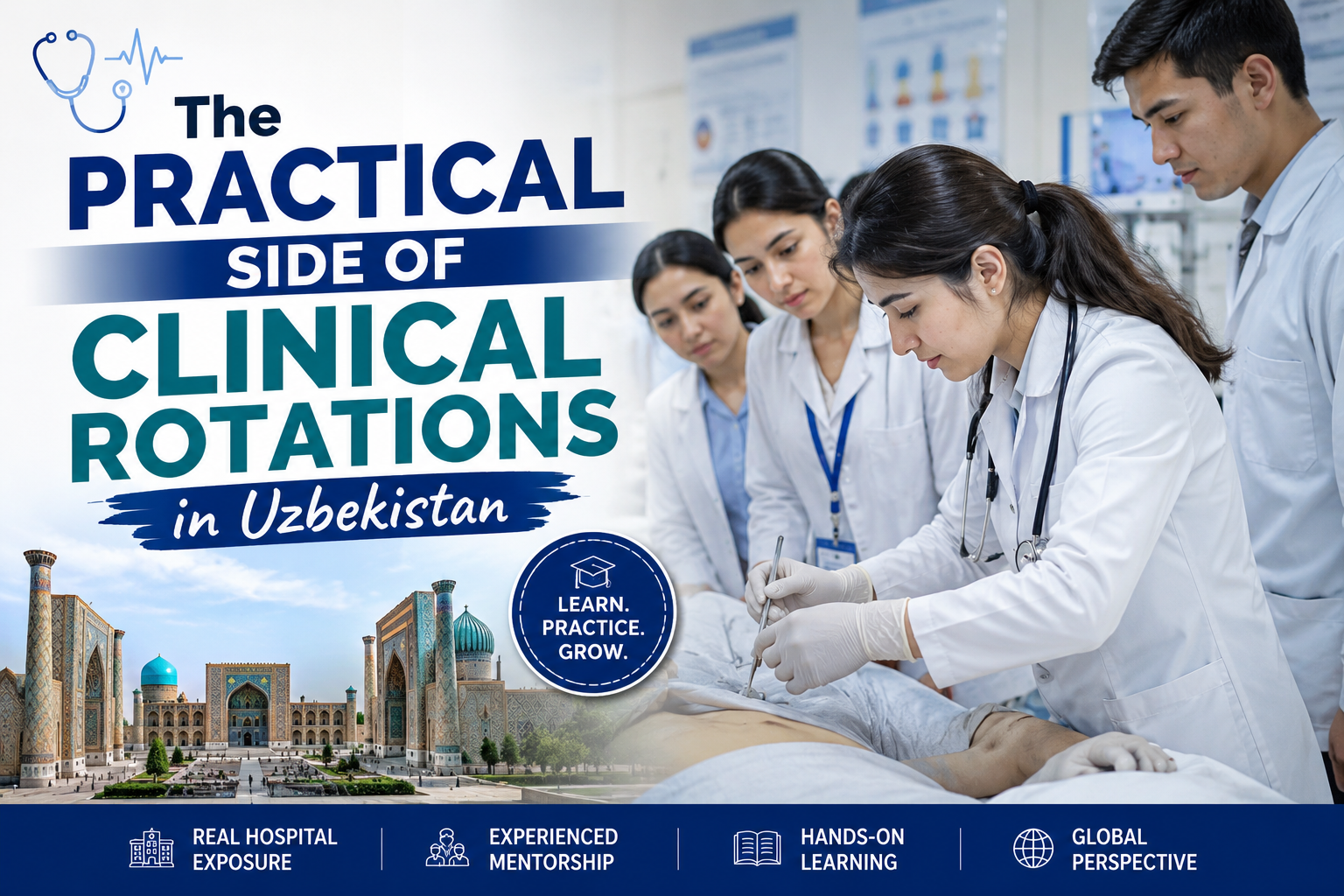
One of the most essential periods in a medical student journey are the clinical rotations. They close the loop between what is in the textbooks and how it actually works clinically. For Students opting for mbbs in Uzbekistan, clinical exposure is formalised, hands-on and up to date with the global medical standards.
This guide will help explain how clinical rotations work in Uzbekistan and what you can expect as an international student during this important phase of the MBBS program.
Clinical rotations are essentially on-the-job training where you work out in a hospital and see real patients, supervised by experienced doctors. This phase generally starts after the first few years of school-based learning.
To confirm exposure to suitable departments, medical universities in Uzbekistan would help students with experiences in various domains like:
General Medicine
Surgery
Pediatrics
Gynecology & Obstetrics
Psychiatry
Emergency Medicine
These rotations help students to practice diagnosis, patient care and treatment procedures in an actual clinical setting.
Clinical rotations usually begin in the third or fourth year of MBBS programs as per most universities providing mbbs in uzbekistan.
Pre-Clinical Years (Years 1–2)
Clinical Subjects — In this semester, students mainly concentrate on theory-oriented subjects i.e Anatomy Physiology and Biochemistry.
Para-Clinical Years (Year 3)
Pathology — has its own unit, which also introduces to the pre-clinical training comprising subjects like Pathology, Pharmacology and Microbiology as well as first clinical exposure.
Clinical Years (Years 4–6)
This is where full-fledged hospital rotations start to happen. Each student is assigned to a department in a rotation.
A standard day on clinical rotations comprises of:
Go with senior doctors to attend ward rounds
Watching patient diagnostics and treatment planning
Assisting in minor procedures
Taking patient histories
Writing case reports
This helps the students to become more confident when dealing with hospital settings in real-life situations, something they will need if they are to go on with their medical careers.
International standards are followed in Uzbekistan medical education to ensure worldwide acceptance.
Several universities align with the standards set by the Who for international health care.
Medical universities can be found in the Wdoms, which grants world-wide recognition for degrees awarded.
If the student is an Indian origin student, approval by the Nmc is very important as this enables the medical graduate to practice in India after giving due examination. Indian students getting admission must also be careful and they should not fall prey to any fake promises made by agents or educational consultants.
Such a global alignment allows students to have the same quality of education and clinical exposure as internationally accepted standards.
The way hospitals are connected with universities in Uzbekistan is that every university has its connected government or private hospital where clinical training is outstanding.
Key features include:
Too much exposure among a huge population
Hands-on practice under supervision
Modern diagnostic equipment
Interaction with experienced medical professionals
In contrast to certain countries where clinical exposure is limited, patients are present from year one and due to the continuity of patient care through decades in one clinic, learning is deepened significantly.
A lot of students even compare Uzbekistan with other countries to make a decision. Moreover, choices such as MBBS in Georgia are popular owing to their European course structure and developed infrastructure.
Uzbekistan is the only notable exception due to:
Affordable tuition fees
Strong clinical exposure
English-medium programs
High patient inflow in hospitals
It proved ideal for students that were looking for their practical experience, and quality education.
At the end of clinical training, students acquire:
Patient communication skills
Diagnostic abilities
Clinical decision-making
Practical medical knowledge
Confidence in handling emergencies
These are the necessary skills that are required in order to become a good doctor.
Although clinical rotations are very helpful, there will be some difficulties that students encounter:
Language barriers with local patients
Adapting to hospital environments
Managing long working hours
Nevertheless, universities usually offer language support and assistance to aid overseas students in integrating.
In Uzbekistan, clinical rotations provide exposure to the applications of theory in practice on patients providing a well rounded, practical learning experience that prepares the students for their future medical practice. Supported by organized training, international exposure leading to recognition and ample practical exposure provides an MBBS in Uzbekistan with the skill set and the confidence that one needs to excel in a medical profession.
Students can also opt for examination alternatives like MBBS in Georgia where then they are free to make their decisions according to their choices and career option choice.
While choosing the right destination is important, clinical exposure lightens your way to become a perfect doctor.
Also, students planning their journey must ensure they qualify NEET as it remains mandatory for pursuing MBBS abroad as per Indian regulations.