
Published at : 2026-06-01 13:34:00 | Views: 2,122
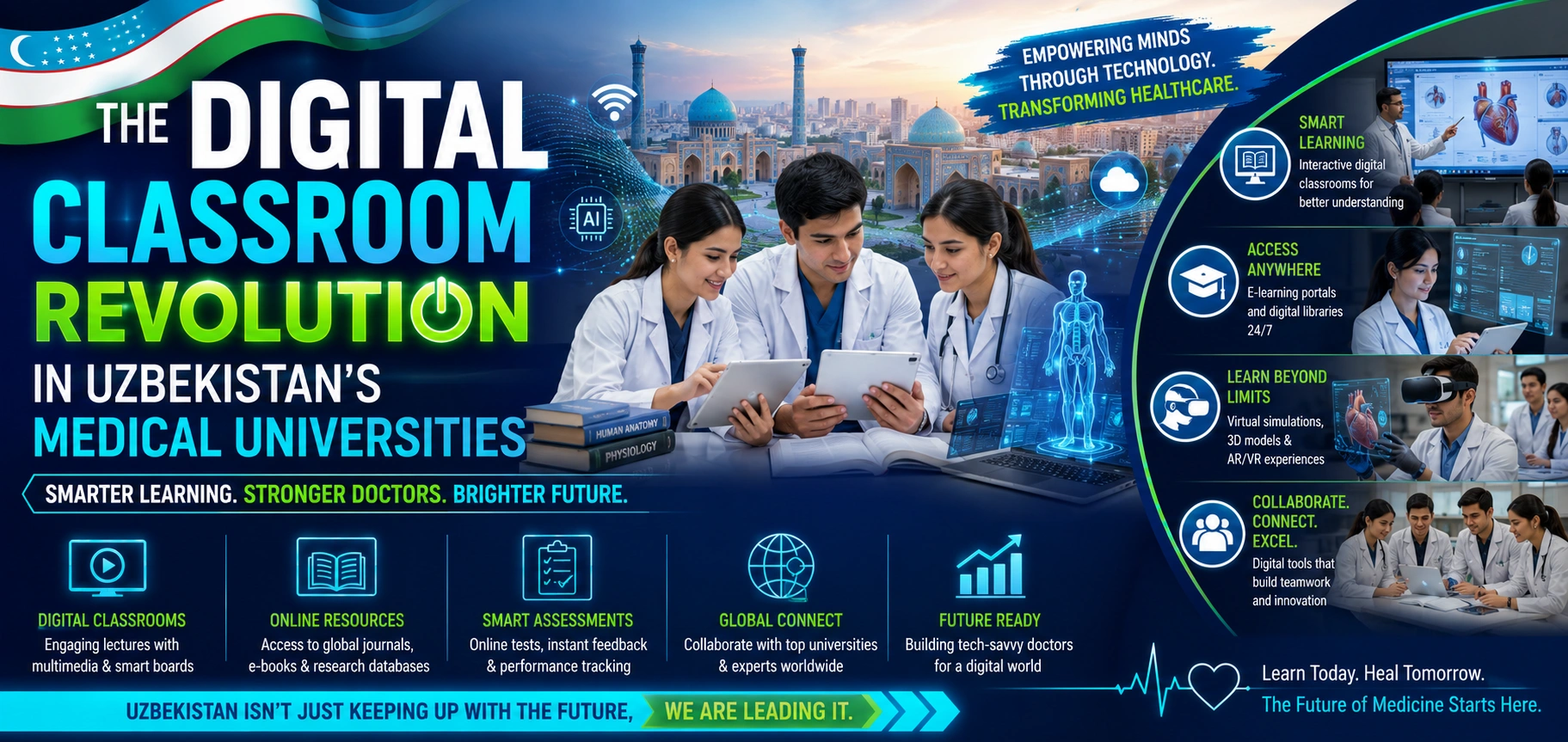
The world of scientific schooling is swiftly evolving, and the era has come to be one of the most effective forces driving this modification. Throughout many nations, universities are adopting digital getting to know structures to enhance the quality of education, enhance pupil engagement, and prepare future docs for an era-pushed healthcare environment. Uzbekistan is among the countries embracing this alteration with excellent pace. Clinical universities throughout the country are making an investment in digital infrastructure, clever lecture rooms, digital laboratories, and advanced instructional technology which can be reshaping how students study medicinal drugs.
For students seeking cheap and modern-day international medical schooling, MBBS in Uzbekistan has ended up an increasingly appealing option. The integration of virtual studying gear into medical programs is helping universities offer an extra interactive, handy, and globally competitive instructional experience. This digital revolution isn't most effective enhancing educational effects however additionally making ready students for the destiny of healthcare.
Scientific schooling has historically relied on school room lectures, published textbooks, laboratory demonstrations, and medical statements. At the same time as those strategies continue to be crucial, the current generation has added new methods of coaching and gaining knowledge that appreciably beautify scholar know-how.
In Uzbekistan’s clinical universities, traditional lecture rooms are progressively being transformed into smart learning environments. Interactive boards, digital projectors, multimedia presentations, and digital getting to know sources are replacing traditional coaching strategies. Students now have the right of entry to visible demonstrations, lively medical models, and interactive content that make complex medical concepts simpler to understand.
Topics which include anatomy, biochemistry, physiology, and pathology often involve targeted systems and processes that can be tough to visualize through textbooks on my own. Virtual equipment allows students to explore those principles in more depth, mainly to progress comprehension and retention.
One of the largest sizable factors of digital transformation is the advent of clever classrooms. Those school rooms are equipped with superior educational technologies that inspire interactive mastering and active participation.
Professors can use virtual displays to demonstrate surgical procedures, explain sickness mechanisms, and give clinical case research in a greater attractive manner. Students can participate in real-time discussions, access digital assets immediately, and have interaction with academic content during lectures.
Using multimedia, gaining knowledge of techniques enables bridge the gap between theoretical knowledge and sensible knowledge. In preference to truly memorizing records, college students can visualize scientific situations and remedy processes through simulations and interactive displays.
Modern-day scientific universities in Uzbekistan are increasingly using learning control systems (LMS) to arrange and deliver academic content material. These structures provide college students with the right of entry to lecture recordings, assignments, shows, examination schedules, look at materials, and educational bulletins.
This virtual accessibility gives full-size advantages for global college students. gaining knowledge is now not limited to study room hours. students can evaluate lectures more than one time, observe at their very own pace, and access educational assets whenever needed.
The power of online studying structures also supports independent examination, that's an important element of medical training. Future medical doctors ought to expand strong self-learning habits because medical expertise continuously evolves in the course of their careers.
In addition, on line communique structures allow students to have interaction with faculty contributors extra efficiently. Questions can be addressed quickly, assignments may be submitted digitally, and educational aid will become extra handy.
Medical training requires getting entry to updated medical records and research. Traditional libraries frequently have limitations concerning the availability of current textbooks and journals. Digital libraries have converted this aspect of getting to know by way of imparting instantaneous get admission to to extensive collections of instructional assets.
Many clinical universities in Uzbekistan now provide digital libraries containing:
medical textbooks
global research journals
clinical case research
scientific courses
Healthcare databases
clinical reference materials
Students can discover recent clinical discoveries, treatment hints, and studies findings without watching for bodily sources. This publicity encourages evidence-primarily based mastering and allows college students to stay knowledgeable about traits in worldwide healthcare.
The growing significance of virtual healthcare schooling aligns with international healthcare projects supported by organizations along with the WHO. As healthcare structures turn out to be an increasing number of technology-pushed, clinical students have to discover ways to get entry to and make use of virtual medical data successfully.
One of the most vital advancements in contemporary medical education is simulation-based gaining knowledge of. clinical universities in Uzbekistan are increasingly adopting simulation laboratories that permit college students to practice clinical abilities earlier than operating with actual patients.
The simulation era creates practical clinical scenarios wherein students can learn and enhance their capabilities in a secure environment. Those laboratories frequently consist of superior mannequins, digital affected person systems, and automated medical simulations.
college students can exercise:
affected person examinations
Emergency reaction tactics
Surgical techniques
clinical diagnosis
critical care management
communique with patients
Simulation-based total education reduces the risk of errors at some point of clinical schooling and allows college students to develop self assurance before entering hospitals and healthcare facilities.
This technique is particularly valuable due to the fact that medicine requires theoretical knowledge and realistic competence. Digital simulation bridges the space among classrooms gaining knowledge of and actual-global clinical experience.
Anatomy is one of the most hard topics in clinical training. Traditionally, students found out anatomy through textbooks, charts, and cadaver dissections. Today, many universities are integrating virtual anatomy software programs and 3-d visualization technology into their curriculum.
These structures permit college students to have a look at organs, tissues, muscle tissues, blood vessels, and skeletal systems from more than one angle. Interactive fashions offer a deeper information of the human body and enable college students to discover anatomical relationships more effectively.
virtual anatomy structures make getting to know more enticing and reachable at the same time as complementing traditional laboratory training.
The healthcare enterprise is presently processing its own virtual revolution. Hospitals and healthcare institutions increasingly rely upon digital medical statistics, telemedicine structures, artificial intelligence, facts analytics, and digital diagnostic systems.
As destiny healthcare specialists, clinical students ought to come to be acquainted with those technologies throughout their education. Uzbekistan's clinical universities understand this want and are steadily incorporating virtual healthcare principles into their academic packages.
students are being introduced to:
digital health information
Telemedicine structures
Healthcare information control
digital diagnostics
synthetic intelligence in healthcare
medical informatics
exposure to those technologies facilitates graduates to adapt more easily to modern healthcare environments.
global college students, specially the ones from India, benefit extensively from the digital transformation taking place in Uzbekistan's medical universities.
English-medium education blended with digital studying assets improves accessibility for college students from different educational backgrounds. Recorded lectures, online look at substances, virtual discussions, and digital exams support a smoother instructional transition.
generation also helps students remain related with educational resources even when analyzing the outdoor lecture room. on-line platforms create a greater bendy and scholar-centered mastering enjoy.
Moreover, digital resources provide access to worldwide scientific literature and exam education materials, assisting students make stronger their educational basis.
College students planning to pursue medical training abroad ought to always verify the popularity in their chosen university. Reputation plays an essential position in figuring out future profession opportunities and eligibility for licensing examinations.
One of the most critical assets for verification is the WDOMS. Universities listed on this directory are identified internationally and are more likely to fulfill worldwide educational standards.
Before applying, college students need to carefully evaluate the recognition popularity in their selected institution to ensure compliance with future licensing and registration necessities.
Indian college students planning to look overseas need to additionally apprehend the guidelines installed through the NMC. Those guidelines define the standards foreign medical graduates should satisfy to pursue medical registration in India.
The NMC emphasizes the importance of adequate direction period, medical education, internship of completion, and educational fine. college students have to make certain that their chosen university complies with these necessities earlier than enrollment.
awareness of regulatory tips allows students to make knowledgeable selections and keep away from headaches throughout future licensing processes.
College students aspiring to pursue medical schooling abroad should additionally stay updated with the eligibility necessities associated with NEET. Qualification standards and examination requirements play an important role in the admission procedure and future medical licensing pathways for Indian students.
The digital lecture room revolution in Uzbekistan continues to be evolving. Universities keep to spend money on educational technologies that improve studying effects and fortify scientific schooling. emerging improvements inclusive of synthetic intelligence, digital reality, augmented truth, and advanced simulation structures are predicted to play a fair greater function inside the coming years.
These traits reflect a broader commitment to creating globally aggressive scientific education applications. Through embracing digital transformation, Uzbekistan is positioning itself as a contemporary vacation spot for global clinical students looking for exceptional education at an affordable fee.
The virtual transformation of Uzbekistan's clinical universities represents a chief step forward in medical schooling. Through smart classrooms, online getting to know structures, digital libraries, simulation-primarily based education, digital anatomy structures, and technology-greater scientific training, students acquire a greater comprehensive and engaging mastering experience.
For college students thinking about MBBS in Uzbekistan, those technological advancements offer massive benefits. They now not simplest enhance educational getting to know however additionally prepare future medical doctors for a healthcare machine increasingly more driven with the aid of innovation and digital generation.
As scientific training keeps evolving, universities that successfully integrate technology into their teaching techniques will play an important position in shaping the following era of healthcare specialists. Uzbekistan’s dedication to digital learning is helping create a modern-day academic environment that aligns with worldwide clinical requirements and future healthcare needs.