
Published at : 2026-08-27 18:55:00 | Views: 2,049
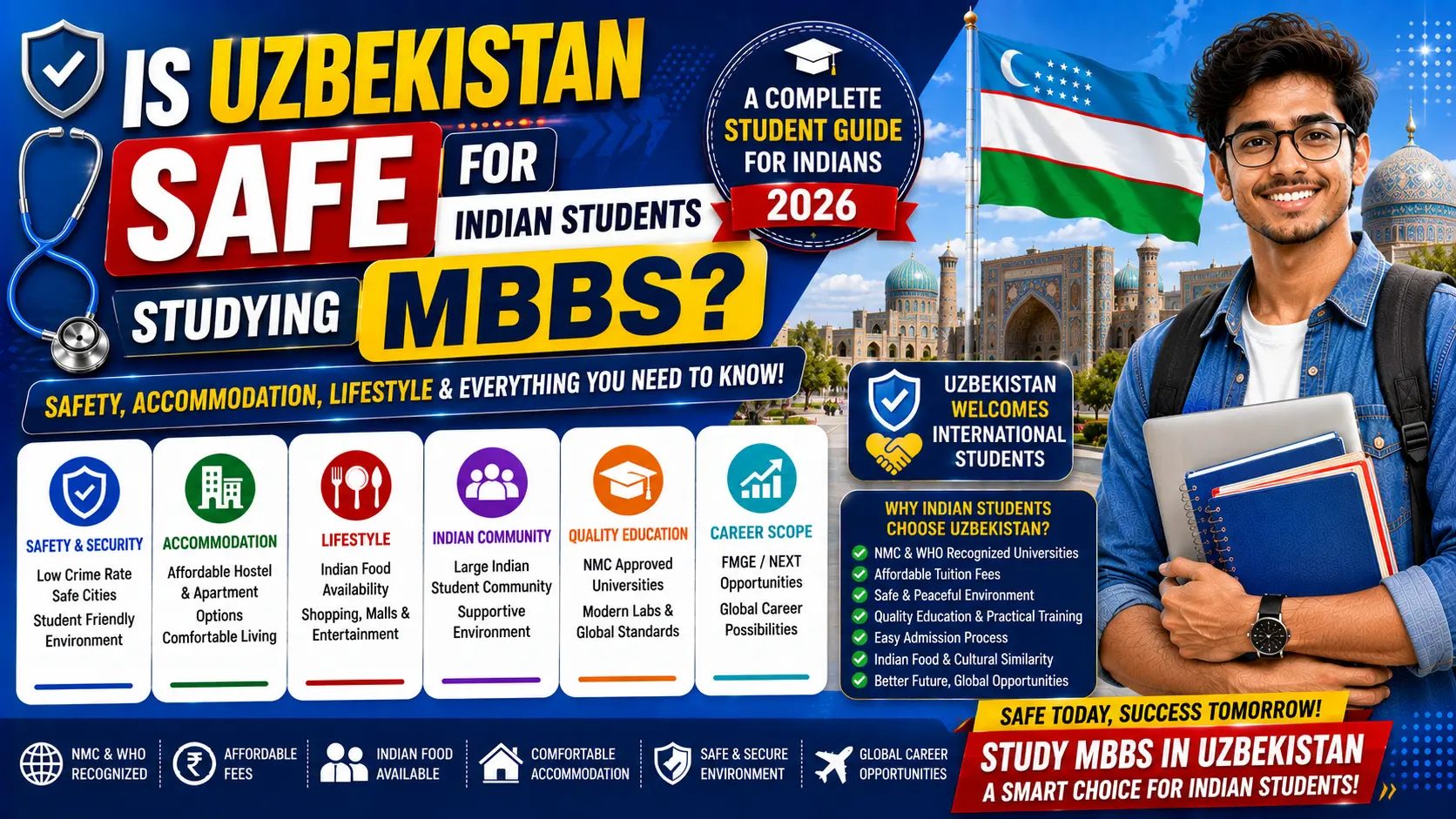
When considering MBBS in Uzbekistan abroad, safety is the main concern for many parents. Parents are generally concerned about costs, rankings, and the availability of the basic amenities one needs to live and sustain oneself, including safe transport and healthy local food, but are also interested in local culture and in what supports the student.
SEO Topic | Key Information |
MBBS in Uzbekistan | A medical education option for Indian students abroad |
Safety for Indian Students | Depends on city, accommodation, university support, and personal precautions |
Accommodation | University hostels and private accommodation are common options |
Student Lifestyle | Includes food, transportation, cultural adjustment, and local customs |
Academic Recognition | Students should verify university and programme requirements before admission |
Uzbekistan is an increasingly popular location for MBBS overseas, and the safety of prospective students is generally reliant on what city they study in, where they stay, personal habits, and the quality of student support. Students need to keep in mind that like other overseas destinations, they need to respect local customs and laws, and also keep their belongings safe, and stay vigilant.
Uzbekistan has developed a student friendly visa policy. Each foreign student gets an A-1 student visa for a maximum of one year at the request of their educational institution. The government of Uzbekistan aims to enhance its international educational services.
For Indian students, academic safety and recognition is also an important concern. Students often find there is a long road ahead and they remain uncomfortable and unsettled in their new home if they find the local medical education does not satisfy their home country’s requirements especially for practicing medicine. The National Medical Commission (NMC) has recommended prospective medical students abroad check thoroughly the details of their prospective education including course duration, language of instruction, curriculum, clinical practice, and the subsequent internship before enrolling.
This guide details safety of Indian students, accommodation, lifestyle, eligibility, fees, admission, medical universities, and other studies while explaining the benefits and career opportunities while also listing the drawbacks and disadvantages to Indian students.
Reasonably speaking, Uzbekistan appears as a fairly safe option for Indian medical students, as long as they choose a credible university, secure trustworthy accommodation, abide by the laws, respect travel regulations, and employ common sense around personal safety.
Areas of particular attention are:
Accommodation verified by the university
Safety and security of travel
Passport and document security
Knowledge of the laws of the land
Emergency contacts and health insurance
Communication with the authorities
Avoid the isolated areas at night
Check the NMC with the medical programme
Safety is but only one factor in the decision for a student to study at a particular international medical school. Students must equally research the academic and the regulatory components to their proposed education.
Generally, Uzbekistan is a popular choice for students from South Asia and beyond. Tashkent, Samarkand and Bukhara, as well as all other university towns, have well-established student communities.
Students must be aware that the level of safety may vary from one university to the next and between various accommodation options. For example, a university-managed hostel may be administered quite differently than a hostel managed by a private company and contracted out to students.
Indian students must:
Secure their passport and residence
Save university emergency contacts
Use only trusted transport services
Avoid being a target by carrying cash
Keep important document copies
Inform friends or a roommate before leaving
Observe the university's guidance
Respect the local laws and customs
Keep the family updated about the accommodation and travel routines to avoid unnecessary travel at night.
Precautions are on point for all international students.
There are several cities in Uzbekistan that offer medical education.
Metropolitan City
More transport and urban amenities
City of the Old Universities
More developed student environment
Smaller City of Significance
Look at where you will live and how you will get around
City of Education
Look at university services
City of the University
Look at the hostel and city transport
Tashkent will probably be the more comfortable city for students who prefer larger cities and more amenities. The smaller cities will have a quieter environment, but students need to be especially careful of transport and the place where they will stay.
This is one of the more critical logistical issues for students when traveling and studying abroad. When trying to find suitable lodging for students, there are generally two options:
This is probably one of the easiest options for first year students.
Advantages are:
Close to the university
More university services
Less travel
More opportunity to meet other students from different countries
Helps students settle in for a couple months
Be sure to ask the university about the hostel's occupancy, heating, internet, security, kitchen, laundry, and visitor policy before booking.
Private apartments are the more popular choice among students for their second or third year.
More independent, but students need to check:
Who the landlord is
What the rental contract is
What the security of the building is
More travel to the university
More distance city
More travel to the university and more cost
Heating and electricity
Availability of the internet
Transportation
More requirements to register
For students looking for MBBS in Uzbekistan for Indian students, accommodation should definitely be included in the total cost and not be left to be assessed at the end.
Cost of living depends on a variety of factors like the city you live in, your type of accommodation, and your way of life. It is advisable for students to prepare a cost of living estimate before they leave.
Costs of a dorm versus a personal apartment
Cost of cooking versus cost of food outside
Cost of public transport versus cost of taxis for long distances
Cost of a data plan and cost to connect
Cost of medical school books and other study resources
Winter clothing and other necessary clothing
Cost of leisure and entertainment
Cost of travel within Uzbekistan versus travel to India
Students are encouraged to keep additional finances for sudden expense to travel, changes to travel plans, sudden requirement to expensive documents, and unplanned medical expenses.
Food changes become less difficult the more you practice. It is especially difficult in smaller cities with fewer options. It is less difficult to find international restaurants and grocery stores in larger cities.
You might experience an initial lack of nutritious food with lentils, grains and vegetarian food. It helps to learn to cook more nutritious foods and can help you save more too.
Students need to learn the local names of their preferred ingredients and make their dietary requests clear.
Students need clear understanding of the customs in new culture and need to dress in line with the customs in the new country. It is necessary to learn the inhabitants customs and social norms as they usually are in contrast to those of India.
Learning a few phrases in Uzbek or Russian can help, especially speaking outside the university.
Students need to fulfill university admission criteria and India's criteria for studying medicine abroad.
Students should have the following:
Completed High School.
Studied the necessary science subjects in High School.
Met PCB and English Eligibility criteria.
Qualified NEET-UG wherever applicable.
Acquired necessary documents.
According to the official NTA portal, NEET-UG is the standardized entrance exam for undergraduate medical studies.
As per NMC, Indian nationals planning to acquire their first medical degree from abroad are required to clear NEET to qualify for admission to the MBBS or its equivalent as per the relevant rules.
From an academic standpoint, it is as imperative that you not only be physically secure.
As per the NMC FMGL FAQ, the overseas medical education must be a minimum of 54 months, have English as the medium of instruction, and consist of theory, practical, and clinical training comparable to the Indian MBBS.
The NMC has issued a warning to Indian students regarding foreign medical institutions that fail to meet the minimum length, curriculum, medium of instruction, clinical training or internship of the prescribed requirements.
Consequently, students must check the particular university and program before making tuition fee payments.
While the procedure differs from one university to the other, the steps are generally as follows:
Check that you have the necessary qualifications and have cleared NEET.
Evaluate the course and compare the teaching language, clinical amenities, accommodation, and overall expenses.
Students can rely on the WDOMS to do their due diligence on medical schools. However, WDOMS should not be construed as a guarantee for Indian licensing.
The typical document checklist includes:
Passport
Class 10 certificate
Class 12 certificate
Marksheets
NEET scorecard
Photographs
Medical documents
University application forms
The university processes the application and issues the admission-related documents.
Students carry out the relevant visa processes and make travel arrangements. Uzbekistan's official government portal has confirmed the A-1 student visa category for foreign students.
Students complete registration and other university-related formalities.
There are no standardized medical university fees across Uzbekistan. Costs are university, course, and year-specific.
Students also have to budget for:
University-specific
Room type and facilities
Personal lifestyle
City and distance
Fees
University/local requirements
Medical Study Materials
India–Uzbekistan travel
Student dependent
Lowest advertised tuition is not a comprehensive cost. Students should request a detailed cost structure to be in writing.
SEO Keyword | What Students Should Check |
MBBS fees in Uzbekistan | Tuition, hostel, food, transport, insurance and personal expenses |
MBBS admission in Uzbekistan | Eligibility, documents, university selection and visa process |
Study MBBS in Uzbekistan | Course duration, teaching language, clinical training and recognition |
Uzbekistan medical universities | Current university status and exact medical programme |
MBBS abroad for Indian students | NMC requirements and applicable licensing rules |
Medical education in Uzbekistan | Curriculum, practical training and internship requirements |
Uzbekistan MBBS eligibility | Academic qualifications and NEET-UG requirements |
Uzbekistan MBBS accommodation | Hostel facilities, private housing, security and transport |
Uzbekistan MBBS fees for Indian students | Complete tuition and living-cost structure |
MBBS degree from Uzbekistan | Recognition, registration and applicable licensing requirements |
Uzbekistan has some well-established medical universities.
Some universities that are the most researched include:
Samarkand State Medical University
Tashkent Medical Academy
Bukhara State Medical Institute
Andijan State Medical Institute
Fergana Medical Institute of Public Health
Students should check the actual recognition of programs instead of assuming that all programs of a certain university have similar regulatory and recognition contexts.
The affordable tuition and living cost draw students to Study MBBS In Uzbekistan.
Students can study in a diversified school environment with students from all over the globe.
Uzbekistan has schools of medicine with a long standing record of teaching and medical training hospitals.
Several schools offer medical training courses in English to International students. Students must check that the course meets the NMC specified medium-of-instructions requirement.
Uzbekistan offers Indian students the opportunity of studying and experiencing the history and traditions of Central Asia.
No international destination is without its challenges.
Class may be in English but communication with students and the public will mostly be in Uzbek or Russian. Interaction with patients will also require knowledge of the languages.
Winters can be much colder than in most of India so students will need to bring appropriate clothing for the colder weather.
This is a far location from India so travel for the longer academic breaks will be expensive and time consuming.
The main academic risk is to select a course that does not satisfy the NMC requirements. The NMC recommends students to check foreign medical courses prior to accepting an offer.
Indian students will not be permitted to practice medicine in India after completion of the medical degree until they fulfill the licensing and registration requirements for the applicable batch.
Indian students have various career options after completion of the degree.
Medical graduates meeting the foreign medical graduate criteria, passing the relevant licensing exam, and completing the required registration, may be eligible to practice medicine in India.
Graduates may pursue postgraduate medical education in India after obtaining the necessary registration, and meeting the entrance and eligibility requirements.
An MBBS degree can be the basis for a clinical and biomedical research career and an academic career.
Graduates interested in the health of populations may obtain additional qualifications in public health, epidemiology, or health care management.
Graduates may pursue other international medical licensing pathways. As each country has its own examinations and registration requirements, an Uzbek medical degree may not be considered to provide licenses for medical practice in other countries.
Arrange travel
Obtain visa
Acquire passport
Arrange assurance
Verify emergency contacts
Learn transportation
Learn university policies
Inform and update family
Avoid unnecessary risks
Verify that travel is to correct university
Register at university
Confirm that hostel is booked
Keep essential documents
Secure passport
Keep emergency funds
Learn basic phrases of local language
Avoid unnecessary risks
Ordinary international safety practices are recommended (e.g., decide on secure accommodation).
Standard precautions are recommended (e.g., be careful traveling in the dark and in unfamiliar places).
Most universities offer or organize accommodation for students, but availability differs. It is advisable for students to contact their respective universities for hostel information.
Yes, vegetarian food is available, more so, in the bigger cities. Students may consider the option of cooking their own food or find suitable restaurants and places to buy food.
Indian students must appear for NEET-UG, as it is mandatory to qualify NEET to allow Indian students to obtain a primary medical qualification, as per the NMC.
Postgraduate medical education from a foreign country may be registered in India if a graduate and the education meets the requirements of the NMC. The NMC specifies requirements under the FMGL concerning the WDOMS listing.
No, WDOMS is a great resource for medical schools, and a listing is not sufficient for a medical school to be eligible for medical registration in India.
Current status of the university, the exact course or program offered, the duration of the course, the medium of instruction, clinical training, internship, local recognition, total fees, and NMC rules pertaining to the year of admission.
Is Uzbekistan safe for Indian MBBS students? Uzbekistan can be a great country for students wanting to pursue and experience an overseas education, as long as students pick their lifestyle, university, accommodation and lifestyle with care.
Choosing a safe country for pursuing an MBBS is important, however, physical safety is only one aspect to consider. There are other dangers that Indian students will face such as academic and regulatory issues. The NMC specifically instructs aspiring foreign medical students to check the duration, syllabus, language of instruction, and the arrangements for clinical practice and internships before confirming their admission.
Considering these points, Indian students desirous of pursuing their MBBS in Uzbekistan have to do their own due diligence on the respective university, contact the university directly, check the accommodation, take necessary travel precautions, and inform their family.
The safest and simplest approach is to select a verified medical program and be a responsible and respectful member of the community. Always keep in mind the Indian medical licensing requirements from the first day of admission.
If proper precautions are taken and planning done ahead of time, MBBS in Uzbekistan is an astute choice for a foreign country for Indian students wanting to pursue a medical degree and wanting to keep costs of education and living low.
National Medical Commission (NMC) — Regulations on medical education in India and foreign medical graduates.
NMC FMGL Regulations and FAQs — Details for Length of course and language of instruction for foreign medical graduates.
National Testing Agency - NEET — NEET UG official updates for 2026.
World Directory of Medical Schools (WDOMS) — Resource pertaining to medical schools.
World Health Organization (WHO) — Resource pertaining to health.
Government of Uzbekistan — Official information about student visas and government procedures.
Official Uzbekistan e-Visa Portal — Visa information and application portal set up by the Government.