
Published at : 2026-08-27 18:52:00 | Views: 2,041
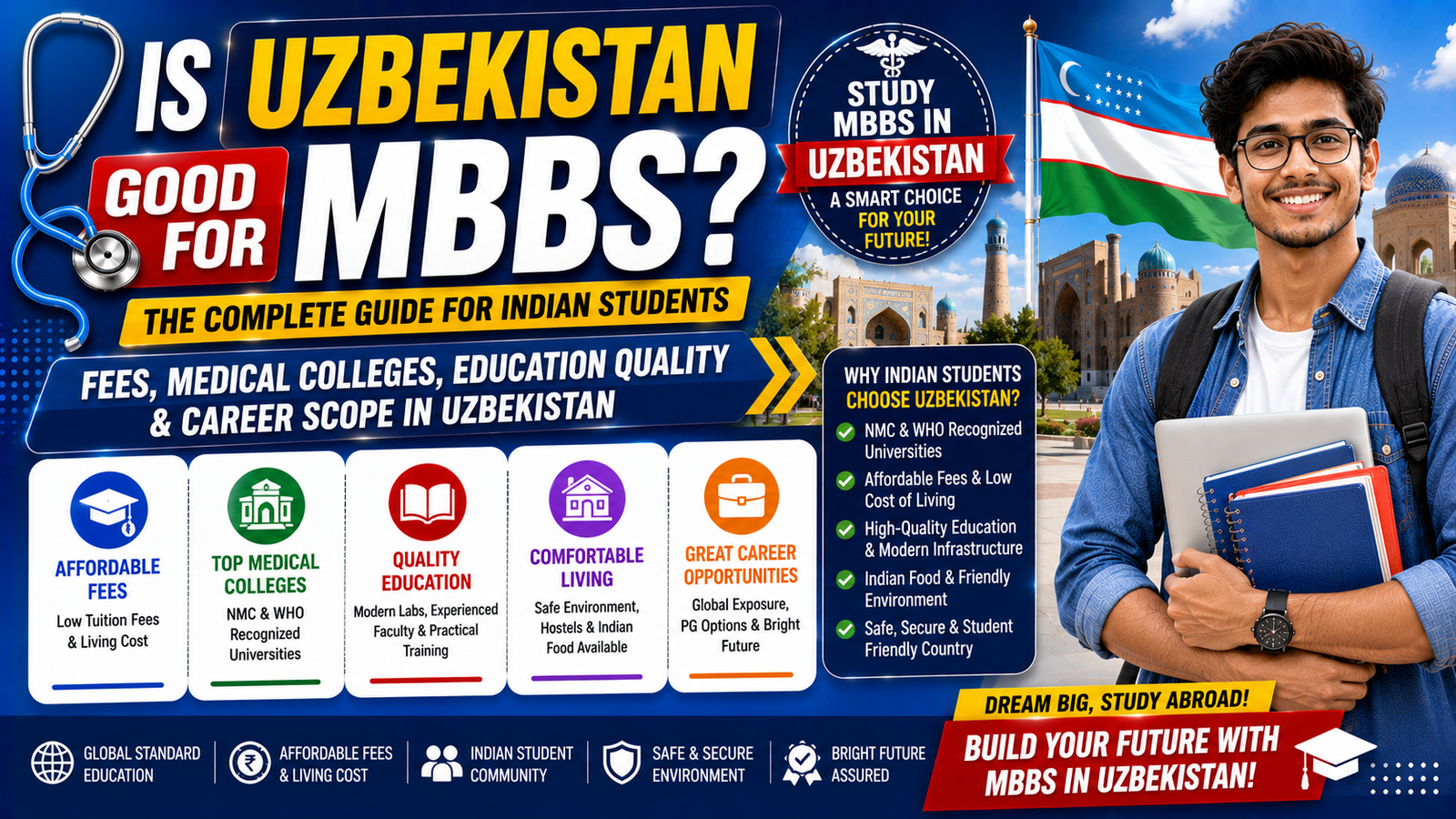
Can't get into a government medical college in India? Looking for an affordable way to study medicine abroad? A lot of Indian students are checking out Uzbekistan these days. But here's the thing—picking a country for medical school isn't just about finding the cheapest tuition. You've got to think about how good the university actually is, whether you'll get real clinical experience, how long the course takes, if it's recognized, what living will cost, and whether you can actually practice medicine back home in India.
So, is Uzbekistan a good choice for MBBS? For plenty of students, the answer is yes—if they pick the right university and double-check the program against the current National Medical Commission (NMC) rules.
The country has solid medical institutions, more and more international students are showing up, and there are programs taught in English. In fact, Uzbekistan's government reported they're doing serious work on higher education reforms, including getting international accreditation and bringing in more international students.
If you're thinking about MBBS in Uzbekistan, this guide will walk you through fees, eligibility, how to apply, which colleges to look at, education quality, pros and cons, and what kind of career you can actually have in India afterward.
Yeah, it can be. Uzbekistan's a solid destination for Indian students who want medical education that won't destroy their bank account and comes from established medical universities. But here's the catch—you need to pick a program that actually satisfies the NMC's Foreign Medical Graduate Licentiate (FMGL) requirements.
Before you enroll, make sure to check:
NEET-UG eligibility
Whether the university and program are legit
How long the course actually is
That it's taught in English
The curriculum and subjects
Clinical training setup
Internship arrangements
If you can practice medicine in Uzbekistan itself
What you need to do for Indian licensing after you graduate
The NMC lists the Foreign Medical Graduate Licentiate Regulations, 2021 and updated FMGL FAQs as the applicable rules to follow.
Uzbekistan's medical education sector has been growing, and it's not an accident. The country's got medical universities with long histories, and they've been investing seriously in healthcare infrastructure, academic programs, and working with international partners.
The Uzbek government reported that there are around 20,000 international students in the country and that international accreditation efforts are spreading across higher education institutions.
Here's something interesting: look at the 2025 FMGE results. According to Uzbekistan's Ministry of Digital Technologies, graduates from Uzbekistan hit a 40.37% success rate on the 2025 FMGE, which puts Uzbekistan fourth globally for countries that educate international medical students. Plus, it's first among CIS and Southeast Asian countries when the government does the comparison.
That's cool data, right? But—and this is important—don't think that a country-level pass rate means you will definitely pass. Different universities have different results, and different students do different things.
If you're an Indian student, you've got to meet two sets of requirements: what the university wants, plus what India requires for citizens studying medicine abroad.
You'll generally need:
Class 12 or something equivalent
Physics, Chemistry, and Biology/Biotechnology
English as a subject
Whatever minimum marks they ask for
A valid passport
NEET-UG qualification (where it applies)
The official NEET-UG 2026 info confirms that NEET is the entrance exam for undergraduate medical education in India.
Pro tip: Always check what the NTA and NMC are asking for in your year instead of using old info. Requirements change.
Seriously, this section matters more than you think for Indian students.
So here's what the NMC FMGL framework says: your foreign medical course has to hit specific standards. The NMC's FAQ spells it out—the program needs to run for at least 54 months minimum, has to be taught in English, and you need theory, practical work, and clinical training that's actually equivalent to what Indian MBBS students get.
There's also something about internships. The current NMC FAQ says FMGs need to complete at least a 12-month internship at the same foreign medical institution they studied at, plus a supervised 12-month internship in India under the framework they're under.
Here's where the NMC gets stern: they've specifically told students to do your homework before joining a foreign medical college. If the course length is different, the teaching language isn't English, the syllabus doesn't match up, the clinical training is weak, or internship arrangements are sketchy—any of that can mess with your eligibility to register in India.
So don't just pick a university because some agent told you it's "NMC approved." Go verify the actual program yourself.
Every university does this a bit differently, but here's what most Indian students go through.
Make sure your Class 12 subjects are right, your grades are good enough, and you've done NEET.
Compare what matters:
Curriculum
How long the course is
What language they teach in
Their clinical hospitals
How internship works
University reputation
Total cost
Housing options
Universities usually ask for:
Passport
Class 10 certificate
Class 12 certificate
Marksheets
NEET scorecard
Passport photos
Medical documents
Application forms
Uzbekistan's official government portal says foreign citizens can definitely study at higher education institutions. Most foreign students get admitted on a paid-contract basis under their system.
After the university looks over everything, they send you the admission documentation.
You complete the visa stuff and register with the university before you start classes.
If you're researching MBBS in Uzbekistan for Indian students, the smart move is to get the latest official admission letter and fee details straight from the university you're looking at.
One big reason students look at Uzbekistan is that it can be more manageable cost-wise compared to private medical colleges in India or some other countries.
But—and this matters—there's no single price that applies everywhere. Tuition shifts depending on the university, what year you're in, what program, and your status as a student.
Expense What You Should Think About | |
Tuition fees | Depends on the university |
Hostel | Room type and which university |
Food | What you spend monthly |
Medical insurance | Depends on what's required |
Visa and residence | Government and admin costs |
Travel | India to Uzbekistan flights |
Books | What the course needs |
Personal expenses | How you live |
Exam/admin fees | University dependent |
Cost Component How Much to Budget | |
Tuition | This is the big one |
Accommodation | Moderate |
Food | Low to moderate |
Transportation | Generally not too bad |
Books and supplies | Moderate |
Travel | Varies a lot |
Insurance and visa | Varies |
Personal expenses | Depends on you |
Here's something important: stay away from websites and agents that throw out a single "total MBBS fee" without actually breaking it down by university. Get them to give you tuition, hostel, registration, exam fees, and everything else separately.
If you're looking into MBBS in Uzbekistan, you'll come across several colleges worth considering.
This is one of Uzbekistan's well-established medical schools. Before you apply, check out their current program structure, what they want from international students, and how their clinical training actually works.
Another big name in Uzbekistan's medical education. You can use WDOMS (World Directory of Medical Schools) as part of your research process to verify the university.
Bukhara's another solid location for medical studies and has a decent number of international students.
Andijan's another option that international students look into.
Fergana's another medical education choice if you're considering international applications.
WDOMS (World Directory of Medical Schools) is super helpful for researching medical colleges worldwide. But remember—a WDOMS listing by itself isn't the same as getting approval for Indian medical registration.
Education quality is huge when you're picking a foreign medical university. Seriously, don't skip this.
Uzbekistan's been updating its medical education system. According to the government, their reforms include updated courses, modern facilities, simulation centers, digital learning tech, international partnerships, and they're bringing in professors from abroad.
They also reported that 40 academic programs at 11 universities got international accreditation as part of these bigger education reforms.
For you as an individual student though, national-level improvements are just part of the picture.
Before you enroll, check whether your university has:
Proper teaching hospitals
Regular clinical rotations
Simulation equipment
Good faculty
English-medium classes
Real patient exposure
Proper internship setup
Clear exam procedures
For a lot of students, Uzbekistan can be a more affordable option for foreign medical education.
Uzbekistan's got medical universities with long academic backgrounds and solid teaching structures.
International students are becoming normal in Uzbekistan's higher education. The government reported around 20,000 international students in the country.
You can find programs taught in English for international students—and this matters for Indian students because English is required under the FMGL framework.
The country's putting money into medical education, technology, and clinical facilities, which means more opportunities for students.
Indian graduates can pursue the Indian licensing pathway after graduation if their education meets the requirements.
Uzbekistan isn't the perfect fit for everyone.
Yeah, the international programs teach in English, but you might run into Uzbek or Russian in day-to-day life and in clinical settings.
Clinical exposure isn't the same at every university. Check what hospitals are actually affiliated before you go by the marketing materials.
Graduation doesn't automatically let you practice in India. You've got to complete the licensing exam and registration process.
If you're from India, Uzbekistan's cold winters, local culture, and food might take some adjustment.
Pick the wrong university and you could end up with academic and legal registration problems. This is why you need to verify the program before you pay anything.
After you finish medical school, there are several paths you could take.
If you meet the NMC requirements, pass the licensing exam, and complete the registration/internship stuff, you can practice medicine in India.
Once you're registered, you can go for postgraduate studies if you meet the entrance and eligibility rules.
If research interests you, there are options like clinical research, biomedical research, and academic positions.
An MBBS degree can get you started on a career in epidemiology, public health, or healthcare administration—though you might need additional qualifications.
You can also explore practicing in other countries. But every country has its own exams, registration process, and credential checks you have to go through.
Don't base your choice on tuition alone.
What to Check Why It Matters | |
WDOMS listing | Helps you find and research the school |
NMC requirements | Important for registering in India later |
Course duration | Has to meet what's required |
Language of instruction | English matters for FMGL |
Clinical training | Determines how much hands-on you get |
Internship | Critical for getting licensed |
Hospital affiliation | Affects how many patients you work with |
Total cost | So you don't get surprised |
Local recognition | Important if you want to practice there |
Student support | Helps with housing and paperwork |
The NMC's official advice on foreign medical education specifically says to do your due diligence. They warn that if course duration, curriculum, clinical training, or internship arrangements don't match requirements, your registration eligibility can suffer.
Yeah, it can be if you want relatively affordable medical education abroad and you choose a program that follows the rules and understand what you need to do for Indian licensing.
A foreign medical degree can support Indian registration when your specific program and you as a graduate meet NMC requirements. A degree alone doesn't automatically give you permission to practice though.
Indian students have to meet the NEET-UG requirements for studying medicine abroad. Check the official NTA NEET portal for your year.
Most programs are six years, but verify the exact length of the program you're looking at and make sure it meets NMC requirements for your admission year.
Costs are different at different universities and years. Uzbekistan gets marketed as affordable, but compare the full tuition and living costs instead of just guessing based on the country.
If you're under the current FMGE framework, you have to pass the licensing exam before you can practice in India. Which pathway applies depends on the rules for your admission and degree.
No way. WDOMS is a great medical school information tool, but just being listed there doesn't guarantee you'll be eligible for Indian registration.
Maybe, but you'd have to meet Uzbekistan's local licensing and registration requirements. Check those separately.
So, is Uzbekistan good for MBBS? For many Indian students, yeah, it can be—especially if affordability, international experience, and established medical schools matter to you.
The country's medical education system is still developing, and 2026 information shows improvements in curriculum, facilities, international partnerships, and clinical education. Uzbekistan also hit a 40.37% success rate on the 2025 FMGE, which is an encouraging sign at the country level—though don't take it as a personal guarantee.
The real question isn't "Uzbekistan or India?" or "Which country is cheapest?" It's: Does this specific university have a medical program that meets the NMC requirements for my admission year?
Before you pay anything, verify the university, the curriculum, the language they teach in, clinical training, internship, local recognition, total fees, and the Indian licensing pathway.
If you do your homework and choose thoughtfully, MBBS in Uzbekistan can definitely be a worthwhile option for foreign medical education in 2026.
National Medical Commission (NMC) — Foreign Medical Graduate regulations and official updates
NMC FMGL FAQ — Course duration, English-medium instruction, and FMG requirements
National Testing Agency – NEET — Official NEET-UG 2026 information
World Directory of Medical Schools (WDOMS) — International medical school information
World Health Organization (WHO) — Global health information and resources
Government of Uzbekistan — Official information on foreign students and higher education
Uzbekistan Higher Education Updates — Official information on higher-education reforms and internationalization