
Published at : 2026-08-27 18:59:00 | Views: 2,047
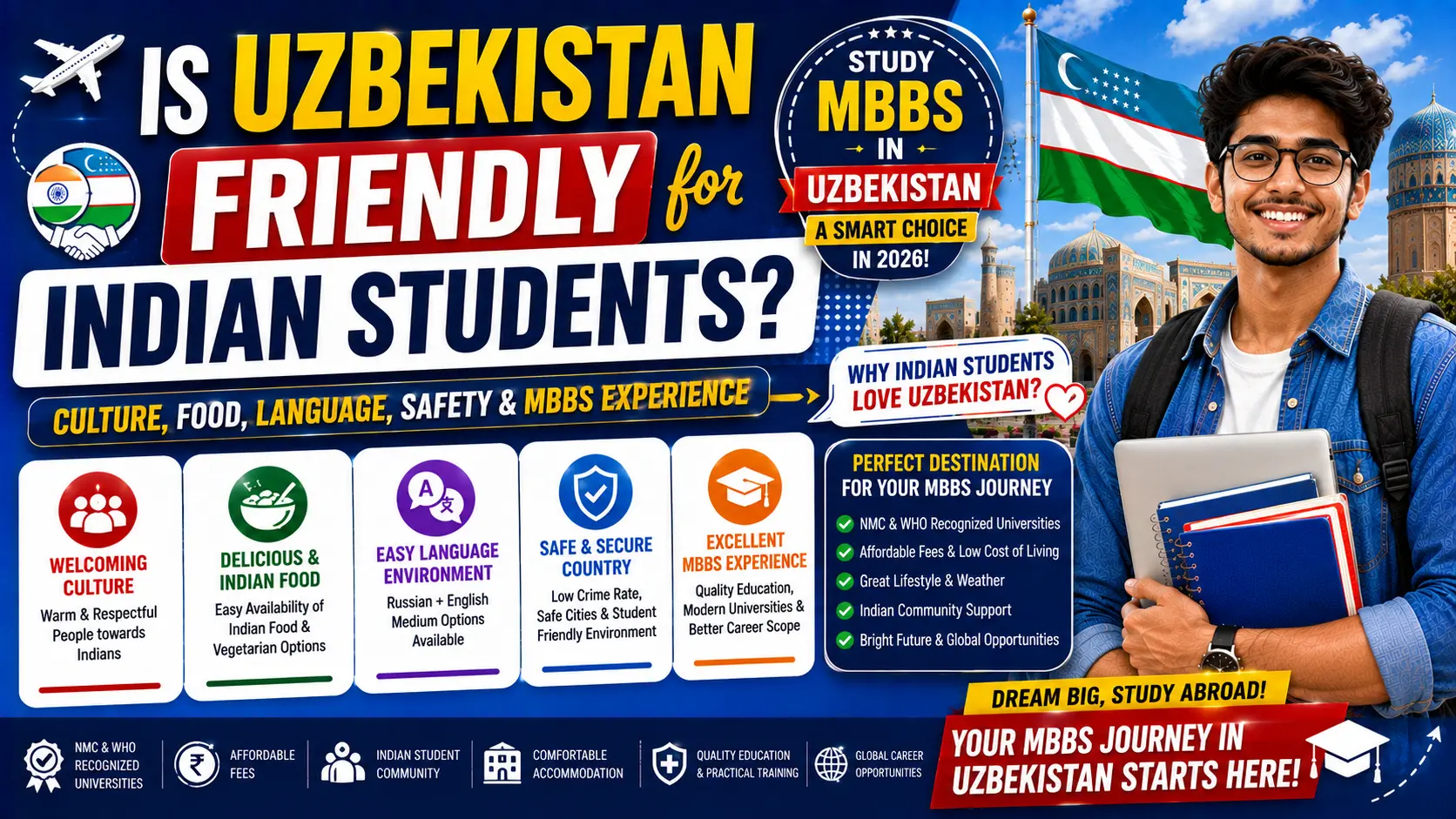
Indian students face different challenges as compared to other international students when they select a foreign university for their medical studies. Students consider the perceived lifestyle and the availability of familiar food and the level of cultural integration and comfort. They want to know how safe the local and university accommodations are and how easily they can adapt to the local culture to make their stay convenient.
For this reason, they want to know about the friendliness towards Indian students before they pursue MBBS in Uzbekistan.
Uzbekistan can be a welcoming country for foreign students. The country is developing its international education sector and the Uzbek government reported having around 20,000 foreign students in its higher education system. They also reported having foreign professors and the internationalization of universities.
However, for Indian medical Students, friendliness cannot be judged solely by lifestyle. University ranking and reputation, clinical training, accommodation and the Indian Medical Council regulations are of paramount importance.
As such, this guide includes everything about Uzbekistan, including what students can expect culturally, and in terms of food, language, safety, accommodation, MBBS eligibility, fees and prospects.
Factor | What Indian Students Should Consider |
Culture | Local customs, social norms and cultural adjustment |
Food | Vegetarian options, Indian food and cooking facilities |
Language | Uzbek and Russian for daily communication |
Safety | Accommodation, transportation and personal precautions |
Accommodation | University hostels and private housing |
Education | University, curriculum and clinical training |
Recognition | NMC requirements and applicable licensing rules |
Uzbekistan is a convenient and welcoming option for Indian students. Most university cities form international communities. Foreigners are accepted in many medical universities, and with some preparation, Indian students can adjust to the new environment. Adapting to a new culture, getting used to colder winters, the language barrier, the absence of family, and the adjustment to life in another country are the main challenges.
Indian students are advised to prepare for:
Uzbek and Russian interactions
New food, customs, and habits
Winters
Hostel life
Getting around and the local transport system
Differences in money, banking, and personal spending
Medical and travel insurance
Matching the NMC's requirements for India
Expand the Uzbekistan higher education system in the coming years. In 2025, there were officially over 207 higher education institutions and approx. 20,000 international students.
Affordability is one reason, but not the only one.
Included in the package is
Long standing universities of medicine
Presence of other international students
Some universities offer medical programs in English with affordable living
Cultural variety
Central Asia is close by
University housing
Some students, looking for MBBS in Uzbekistan for Indian Students, need to check universities one by one. Trusting a country's reputation is not a substitute for checking medical programs.
Traditions and customs are different, but students adapt quickly. Uzbekistan's history is a mixture of Central Asian, Persian, Turkic, and Islamic cultures, and includes social elements of family, hospitality, and respect of the elders.
Indian students may find some dissimilarities in:
Attire
Social customs
Religious practices
Timings of meals
Styles of communication
Norms surrounding gender
Behavior in public
One of the strategies to better adapt to this new environment is to watch and learn the appropriate behavior to fit in, rather than expecting things to work the same as in India.
International students can establish connections with students from the same country of origin in the international student communities available in most of the universities. This helps them overcome the difficulties of communication, new lodging, and the new system of education.
The government of Uzbekistan has also observed an increase in international students and foreign academic staff as a positive indicator of the globalization of higher education.
Food is one of the major concerns of students going abroad.
Some of the traditional Uzbek dishes are:
Plov
Samsa
Lagman
Manti
Shurpa
Bread and some milk products
Rice-based dishes
Indian students who prefer a vegetarian diet will need to express this clearly.
Vegetarian meals can be provided, but students should not expect every restaurant to recognize requests for vegetarian meals as opposed to non-vegetarian meals.
It is also helpful if students learn some basic food-related Uzbek or Russian vocabulary.
Cooking in hostel kitchens where allowed
Some Indian packaged food with some spices
Joining the Indian student community and shopping in local stores
vegetarian restaurants
Finding restaurants that vegetarian meals are offered
In cities like Tashkent, students are more likely to find restaurants with international cuisines and food products. However, the local markets may not have some Indian ingredients and may be expensive.
Cooking straightforward Indian dishes can also help save money at the end of the month.
Some students can be overly optimistic about certain things.
Although some universities offer some medical programs for international students in English, that doesn’t guarantee everyone outside of the campus will speak English.
Uzbek is the official language of the state, while Russian is often found in urban areas and the educational system.
Students may need to speak Uzbek or Russian for:
Shopping
Taxis
Government offices
Housing
Restaurants
Day to day conversations
Some clinical students
This is even more vital for medical students, as clinical teaching will be unlike what they are used to in the classroom.
Learning a few words and phrases in the first semester is a good idea.
Students don’t have to aim for fluency right away. Having words for directions, food, basic numbers, and greetings, and some medical words and phrases is helpful.
Concern for child safety when traveling overseas is justified.
Uzbekistan has focused its institutional efforts to ensure safety for students. In April 2026, the Uzbek Ministry of Higher Education and the Ministry of Internal Affairs held a meeting to discuss the prevention of crime related to university students, monitoring living conditions in student dormitories and rented accommodations, and the creation of the “Safe Student” App.
Students are still required to exercise basic safety precautions.
Indian students should:
Keep their passports and residence documents safe and secure.
Avoid traveling at night and alone.
Always use safe and secure modes of transportation.
Always save the emergency number for their university.
Avoid having too much cash.
Keep important documents safe and secure.
Tell family or friends about long-distance travel.
Comply with university policies.
Refrain from illegal activities or drug use.
Follow laws and customs of the country.
Students must check their accommodations before fully moving in.
Accommodations significantly affect the quality of the student experience.
University hostels are convenient for first-year students and minimize commuting.
However, before accepting a place in a university hostel, consider:
How many students will share the room?
Will the room have heating?
Is there a kitchen on the premises?
Is Wi-Fi available?
Will there be laundry on the premises?
What are the check in and check out times?
Is there on the premises security?
Are guests allowed?
How far is the hostel from the teaching hospital?
Private accommodation is often desirable for first year students in order to minimize commuting, and often offers a greater level of community than a university hostel.
However, first year students should check the landlord, rental agreement, location, transportation and registration before paying.
Accommodation Type | Positive Aspects | Potential Challenges |
University hostel | Convenient and nearby community | Less privacy |
Shared apartments | More independence | Shared community responsibilities |
Private apartments | Privacy and independence | More expensive |
Staying with relatives | Community and independence | Less private |
As a student safety measure, Uzbek authorities have stated they are monitoring the living conditions of students in dormitories and rented accommodations.
In addition to studying medicine abroad in India, Indian students are also required to meet the university's admission requirements.
Usually, students are required to have:
Completed Class 12 or an equivalent
Completed subjects
Physics, Chemistry and Biology / Biotechnology where relevant
English
Achieved the necessary marks in the relevant subjects
Qualified for the NEET-UG exam if necessary
Possess a current passport and the necessary supporting documents
For the latest exam pattern and details for undergraduate medical admission, please visit the official NEET-UG website.
The NMC requires Indian citizens to meet the NEET obligation too.
Compliance is a must.
The FMGL FAQ suggests that medical courses abroad that fulfill the 2021 guidelines must be at least of 54 months and must have the medium of instruction as English and must be comprised of theory and practical and clinical training as in the Indian MBBS.
NMC has also warned students that varying aspects of the course such as duration, medium of instruction, curriculum, clinical training, and internship in India would affect the eligibility for registration in India. The advisory clearly indicates that students must perform due diligence before taking admission.
This means students must check for the precise program instead of believing "NMC-approved university" and similar statements.
Although the admission process is different for every university, Indian students typically complete the following steps:
This involves checking if they meet the academic qualifications and NEET requirement.
This involves looking at the curriculum, the language of instruction, available hospitals, hostels, and the overall costs.
Students must check the medical school in the World Directory of Medical Schools (WDOMS). As a case in point, WDOMS lists Samarkand State Medical University as a public medical school that is operational and was established in 1930.
WDOMS has also listed Tashkent State Medical University as an also operational public University with a six year program of Physician (General Medicine).
However, a WDOMS listing is not to be taken as approval for automatic registration in India.
Essential documents usually consist of:
A valid passport
Class 10 certificate
Class 12 certificate
Marksheets
NEET scorecard
Passport size photographs
Medical documents
University application forms
Students are notified of the admission decision via the admission letter.
Uzbekistan offers student visas to foreign learners. The relevant government webpage states that the STD student entry visa is offered to foreign learners who will pursue temporary studies at higher learning institutes.
Fees differ per university and per academic year, hence, students should request the latest fee schedule in writing.
Expense | Main Cost Factor |
Tuition | University and Programme |
Hostel | Room and Facilities |
Food | Personal lifestyle |
Transport | City and Daily Travel |
Visa/residence | Applicable fees |
Insurance | University and Local |
Books | Medical Course |
Flights | India - Uzbekistan |
Personal Expenses | Individual lifestyle |
The most effective method to estimate your budget is to sum tuition, hostel, food, transport, travel, insurance, and personal expenses, rather than considering tuition alone.
When researching Study MBBS In Uzbekistan, Indian students will find several well-established universities.
For example:
Samarkand State Medical University
Tashkent State Medical University
Bukhara State Medical Institute
Andizhan State Medical Institute
Fergana Medical Institute of Public Health
WDOMS has several of these universities and has other Uzbekistan medical schools in its international medical schools' database.
Make sure to always check the latest curriculum and not only the university name.
Uzbekistan is a good option for families looking for affordable medical school when compared to the other private medical schools.
Uzbekistan offers students the opportunity to work with students from a variety of countries in a different medical system.
Uzbekistan's medical schools have been in operation for a long time. For instance, the Samarkand State Medical University has been providing educational services since 1930.
Uzbekistan's International programs may be offered in English, but the students must confirm the language of instruction.
Students will get an opportunity to experience the history and traditions, and the architecture of Central Asia.
Completing Advance communication tasks may be necessary.
Its colder in winter than the majority of India's winter.
Missing family, Indian food, and social life is a possibility.
May be unable to effectively communicate with patients if the language is not learned.
May face serious consequences if the selected program does not comply with the NMC regulations.
Indian students may pursue
Practice medicine in India after obtaining the necessary licenses
Attend postgraduate medical school
Work in a hospital
Conduct medical research
Work in the field of social medicine
Community medicine
Regulatory changes provided by the NMC during and after the course will permit further opportunities for licensure.
Area | Likely Experience |
Food | Flexible; more effort required for vegetarians |
Language | English in some classes; Uzbek/Russian outside classrooms |
Safety | Standard precautions apply |
Accommodation | Hostels and private rentals may be an option |
Weather | Harsh winter months |
Social life | Mix with students both local and international |
Cost of living | Varies with choice of city |
Culture | Central Asian with variety of local differences |
Travel | Need to travel abroad to reach India |
Academic adjustment | More focus on self-discipline |
Those who have an idea of what to expect are likely to adjust better compared to those who think this overseas exposure will be like any other experience outside of India.
Yes, Indian students can expect a warm welcome in Uzbekistan. Indian students have already become part of the international student community in Uzbekistan, although it can be very different depending on the city and university.
Yes, vegetarians can find suitable diets and can even cook if they have the facilities and choose the right eateries. It helps to have some Uzbek or Russian language food vocabulary.
Some international academic programs have English, but that doesn’t mean English is spoken outside of the university. Daily life is easier with a little Uzbek or Russian.
Students have a safe experience as long as they respect the laws and practice normal safety precautions. There are safety initiatives for students including for dorms and other rented accommodation.
Indian students looking to enroll in a medical degree program abroad are required to fulfill the NEET criteria. Refer to the latest NTA and NMC guidelines pertaining to your admission year.
If the program and graduate meet the NMC criteria, then it could be recognized in India. Important factors include the length of the program, the language of instruction, the curriculum, clinical training, and the internship.
No. WDOMS is a resource containing information on medical schools. Listing within this resource should not be construed as granting automatic approval for medical registration in India.
Prior to admission, students must verify the university's up-to-date information, the exact program, and the duration of the course. The language of instruction, clinical training and internship, accommodation arrangements, total fees, and the NMC regulations for the respective admission batch must also be verified.
Is Uzbekistan a good place for Indian students? Generally, yes, it helps that the country has several medical universities and a higher education system that is increasingly accommodating to international students. Indian students can culturally adapt to the lifestyle in Uzbekistan. It is important to note that Indian students will face some challenges to adjustment in the early period after arrival, including homesickness, food differences and colder weather than Indian students are used to. It will also be necessary to learn both Uzbek and Russian.
Though the changes will be difficult and students will face initial homesickness, if adequate preparations are made before departure students will be able to stay in touch with their university, and secure a safe, comfortable place to stay and learn the rudiments of the local language.
For students interested in Studying MBBS in Uzbekistan, the primary concern is not just knowing if the country is accommodating. It is also vital to check the specifics about the medical school and its programs. The NMC's current advisory notes that foreign medical students should ensure and check the school’s course length, the English-speaking medium, the curriculum, and the clinical teaching and internship placements.
Studying MBBS in Uzbekistan can, therefore, be a success if a student has: Selected a good university, adjusted to the way of life in Uzbekistan, and has an understanding of the Indian licensing pathway even before starting the MBBS.
National Medical Commission (NMC) - Official regulations and guidance for foreign medical graduates.
National Testing Agency - NEET - Official NEET-UG details for medical admissions.
World Directory of Medical Schools (WDOMS) - Medical school and program details.
World Health Organization (WHO) - Health and medical resources.
Government of Uzbekistan - Official resources for higher education, safety of students, and visas.