
Published at : 2026-09-14 11:04:00 | Views: 2,053
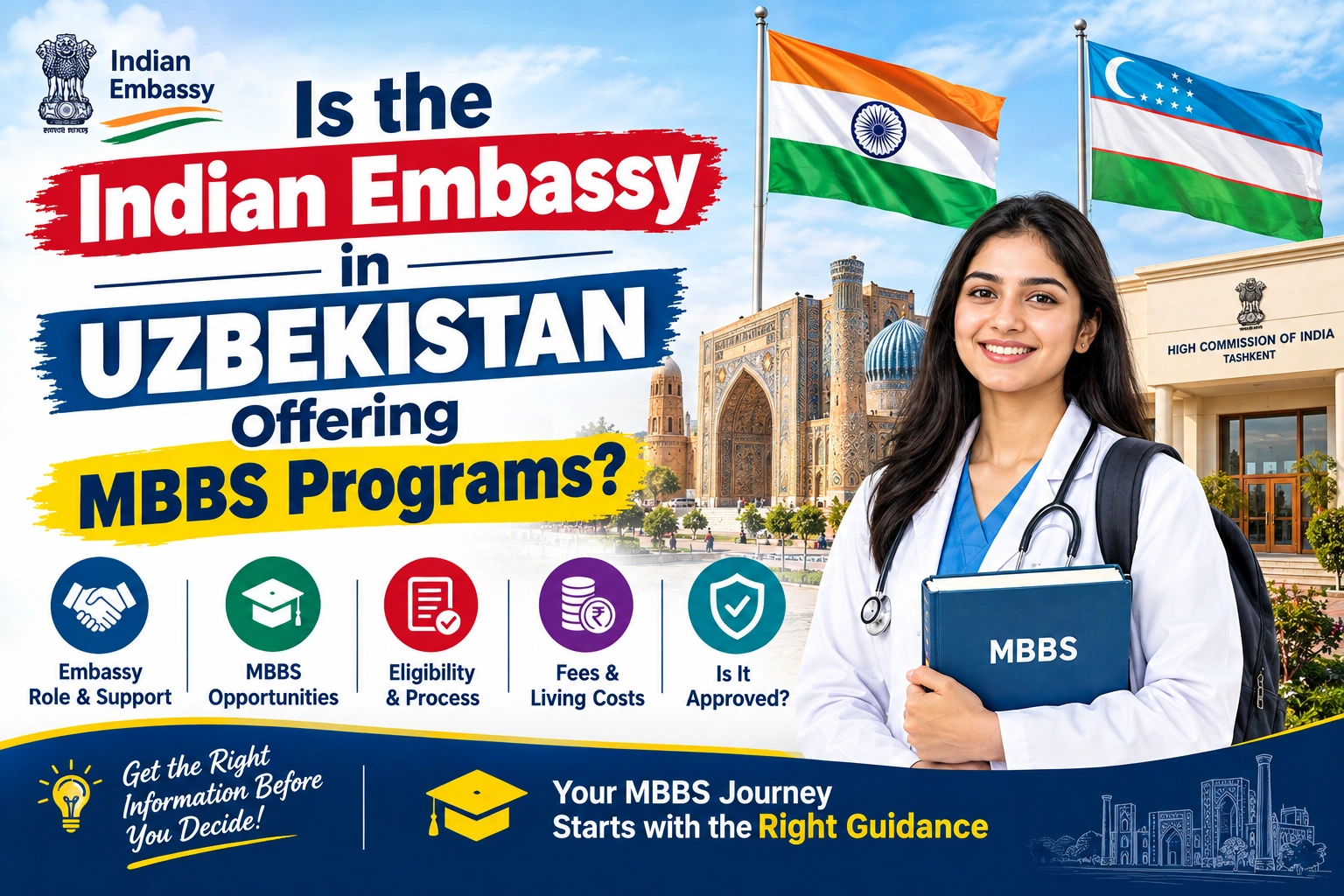
A message arrives on WhatsApp: “Indian Embassy-supported MBBS admission in Uzbekistan. Limited government seats. Apply now.” It sounds trustworthy. Official, even. But the claim is misleading. The Indian Embassy in Uzbekistan does not operate medical colleges, offer MBBS programs, reserve admission seats, collect university fees or issue medical degrees. Uzbek medical universities provide the courses, while the embassy performs diplomatic, consular and student-welfare functions. Students planning MBBS in Uzbekistan should understand this difference before handing over documents or paying an agent. Simple point. Very important. The embassy may publish advisories, share safety information, encourage student registration and assist Indian citizens during genuine emergencies, but it doesn’t select candidates for Uzbek universities. An admission letter must come from the concerned university or its legally authorised channel—not from the Indian Embassy in Tashkent.
No confusion here. The Embassy of India in Tashkent represents the Government of India in Uzbekistan and supports diplomatic relations, trade, cultural cooperation and Indian citizens living or studying there. It is not an educational institution.
The embassy doesn’t:
Run an MBBS college or teaching hospital
Conduct medical entrance examinations
Issue university admission letters
Reserve “embassy quota” seats
Decide tuition or hostel charges
Collect admission fees for Uzbek institutions
Award an MBBS or MD qualification
Guarantee NMC registration in India
Guarantee success in FMGE or any future licensing examination
If a consultant advertises “Indian Embassy MBBS admission,” ask for the claim in writing and verify it independently. Most likely, the wording is being used to create trust around an ordinary university application.
Think of the embassy as an official support and communication point, not an admission office. Its student-related role begins mainly through public advisories, consular support and emergency coordination.According to its official student guidance, Indian nationals arriving in Uzbekistan for a long-term stay are advised to register their details with the embassy. Registration helps the mission contact students during emergencies, local disruptions or urgent public-safety situations. It doesn’t validate their university or convert a questionable admission into a compliant one.
The embassy may assist with:
Registration of Indian nationals living in Uzbekistan
Passport-related consular services
Emergency communication and coordination
Guidance after loss of passport or travel documents
Welfare concerns involving Indian students
Public advisories about education, safety or local rules
Communication with local authorities in serious cases
Evacuation coordination during exceptional emergencies
Information about maintaining lawful residence status
Honestly, students often expect an embassy to resolve academic disputes, refund university fees or force a college to change its rules. That may not be possible. The mission can raise concerns and guide a student, but contractual and academic disputes remain subject to university procedures and Uzbek law.
Medical education is delivered by universities and institutions authorised under Uzbekistan’s education system. Indian students commonly explore options such as Samarkand State Medical University, Bukhara State Medical Institute, Andijan State Medical Institute, Fergana Medical Institute of Public Health, Tashkent-based medical institutions, Urgench State Medical Institute and Karakalpakstan Medical Institute.
These institutions—or their properly verified admission channels—handle the actual process:
Responsibility | Appropriate Authority |
Medical course and curriculum | Uzbek medical university |
Admission or invitation letter | University or authorised admission channel |
Tuition-fee schedule | University |
Hostel allotment | University or approved hostel operator |
Student visa processing | Relevant Uzbek authorities and official channels |
Indian student welfare support | Indian Embassy in Tashkent |
Indian medical education regulations | NMC |
FMGE administration | NBEMS |
NEET examination | NTA |
University names and structures can change because of mergers, restructuring or branch conversions. Don’t rely on an old brochure. Verify the institution’s current legal name, campus location and authority to train international medical students before applying for MBBS in Uzbekistan.
Here is the part that gets twisted in advertisements. An embassy may publish a list of institutions where Indian students are studying or issue advisories concerning certain colleges. Such information shouldn’t automatically be interpreted as a recommendation, approval or quality ranking.The Indian Embassy generally doesn’t certify that a medical programme satisfies every requirement for registration in India. That assessment depends on the course itself and the regulations applicable to the student’s batch. A university appearing in an embassy advisory simply means the mission has shared information about it. Nothing more.Likewise, phrases such as “Embassy approved,” “Indian government affiliated” or “recognised by the Indian Embassy” need documentary proof. Usually, there is no formal recognition category with those exact meanings.
Start with the course, not the sales pitch. Indian applicants should examine the Foreign Medical Graduate Licentiate Regulations and current public notices available from the National Medical Commission. The name of a university matters, but the structure of the qualification matters too.
Students should obtain written confirmation about:
Total duration of medical education
Internship duration and location
Medium of instruction throughout the programme
Subjects covered in the curriculum
Hands-on clinical training
Eligibility for medical registration in Uzbekistan
Whether the entire programme is completed at one institution and campus
Any transfer, branch or offshore teaching arrangement
A school may also appear in the World Directory of Medical Schools, but a WDOMS entry is not the same as approval by the Indian government. The directory itself does not promise eligibility for registration in India.Students sometimes hear that a university is “WHO approved.” That phrase deserves caution as well. The World Health Organization works on international public health; it doesn’t operate a simple global approval scheme guaranteeing that every listed foreign medical programme will be accepted by the NMC.
For an Indian student who wants to study medicine abroad and later pursue medical registration in India, qualifying NEET is a basic requirement under the applicable Indian framework. The latest examination notices, application dates and results should be checked through the official NEET website.Merely appearing isn’t enough. The candidate must qualify for the relevant admission year and should preserve the result document carefully. A foreign university might admit an international student based on Class 12 marks alone, but that doesn’t remove Indian regulatory conditions.
Applicants generally need:
Class 12 with Physics, Chemistry, Biology and English
The required PCB percentage under applicable rules
A qualifying NEET result
A valid passport
Class 10 and 12 certificates
Birth certificate, if requested
Passport-size photographs
Medical fitness and laboratory reports
University admission or invitation letter
Visa-related documents
The embassy doesn’t conduct NEET counselling for foreign universities. It also doesn’t allot Uzbek medical seats based on NEET rank.
Fees look affordable. Often they are. Still, the first quotation rarely shows the entire six-year expense.For MBBS in Uzbekistan, tuition commonly falls in an approximate range of USD 3,000 to USD 5,000 per year, depending on the institution and programme. Hostel charges may range from roughly USD 500 to USD 1,200 annually, while food and personal expenses can add around USD 100 to USD 200 per month. These are planning estimates, not fixed university prices.A family may need an overall budget of approximately ₹25 lakh to ₹35 lakh for the full course. In some cases, it can go higher due to exchange-rate movement, airfare, insurance, coaching and lifestyle.
Expense | Approximate Range |
Annual tuition | USD 3,000–5,000 |
Hostel per year | USD 500–1,200 |
Food and personal expenses | USD 100–200 per month |
Insurance, visa and registration | Variable |
Return airfare from India | Variable |
Estimated complete budget | ₹25–35 lakh |
The Indian Embassy doesn’t set, regulate or collect these university fees. Payments should go only to the institution’s verified bank account or another officially documented recipient. Ask for a receipt. Every time.
One figure on a brochure can hide quite a bit. Apart from tuition and hostel charges, a student may need money for document translation, notarisation, residence registration, visa extension, health insurance, medical tests, local transport, winter clothing, laboratory materials and examination charges.
There may also be expenses for:
Hostel security deposits
Mess or Indian food services
Airport pickup
SIM card and internet
Textbooks or digital subscriptions
FMGE preparation classes
Annual travel to India
Temporary accommodation during holidays
Degree legalisation or document attestation
Ask the university for a year-wise fee sheet before accepting admission. If an agent refuses to provide one, pause. That reluctance tells you something.
A scholarship announcement may occasionally be shared through official diplomatic or government channels, but this does not mean the embassy itself runs an MBBS programme. Any scholarship will have a named sponsoring authority, eligibility rules, application portal, deadline and participating institutions.
Be suspicious of phrases such as:
Embassy scholarship seat
Direct embassy admission
Indian government MBBS quota in Uzbekistan
Guaranteed embassy-sponsored medical seat
Free MBBS approved by the Indian Embassy
Request the original notification on an official government or university domain. A cropped poster, forwarded PDF or WhatsApp voice note isn’t evidence.
In most cases, the main intake process begins between May and September, although dates vary across institutions. Students shouldn’t send original passports to an unverified intermediary just because the academic session is approaching.
A safer process looks like this:
Qualify NEET and check Indian eligibility conditions.
Shortlist universities after reviewing curriculum, internship and clinical training.
Confirm the institution’s current status and WDOMS entry.
Submit academic documents through a verified channel.
Receive and authenticate the university admission or invitation letter.
Obtain a complete written fee structure.
Pay only through traceable, documented methods.
Complete the correct student-visa procedure.
Travel after confirming hostel and reporting arrangements.
Register with the Indian Embassy after reaching Uzbekistan.
That last step supports safety and communication. It is not part of the university seat allotment.
A medical course marketed to Indian students is commonly presented as a six-year programme. Yet the brochure’s “six years” label isn’t enough. Applicants must verify how many months involve classroom study, clinical rotations and internship, and whether training is conducted at the same institution or an approved affiliated hospital.Current Indian rules generally require at least 54 months of medical education and a 12-month internship for foreign medical graduates, along with other conditions. Students should check the precise regulations applicable to their admission batch rather than treating this summary as a substitute for the official text.Language matters too. Lectures may be offered in English, but patient interaction often requires Uzbek or Russian. Students who avoid the local language can lose valuable bedside learning. Clinical medicine isn’t learned only through slides.
Graduating from an Uzbek university doesn’t automatically provide a licence to practise in India. Eligible foreign medical graduates must follow the Indian registration pathway in force at that time, including the applicable screening or licensing examination and internship requirements.FMGE currently requires candidates to obtain at least 150 marks out of 300. The examination is broad and tests pre-clinical, para-clinical and clinical subjects. Students pursuing MBBS in Uzbekistan should begin Indian exam-oriented revision early rather than waiting until graduation.NExT has also been discussed as a future licensing route. Since implementation rules and transition arrangements may change during a six-year programme, students should monitor NMC and NBEMS notices throughout their studies.
Why are Indian families considering Uzbekistan at all? Cost is one reason, but not the only one. Several institutions have growing Indian communities, English-medium options and comparatively accessible admission requirements.
Possible advantages include:
Lower tuition than many Indian private colleges
A six-year medical-study structure at several institutions
Growing Indian student population
Direct flights or manageable travel connections
Hostel and Indian food options at popular campuses
Increasing awareness of FMGE preparation
Possible limitations include:
Uzbek or Russian needed during clinical interaction
Academic quality varies between institutions and campuses
Harsh winter conditions for some students
Additional FMGE preparation expenses
Hostel and food standards may differ from advertisements
Regulatory risk if the course structure is not compliant
Limited embassy power in private academic or financial disputes
A balanced decision needs both lists. Not just the attractive one.
No. It does not run medical programmes, allot seats or issue admission letters. Admission is handled by Uzbek universities and their verified channels.
There is no standard “Indian Embassy quota” for MBBS seats. Any person claiming such a quota should be asked to provide an official embassy or government notification.
The embassy publishes useful advisories, but students must independently compare the complete medical programme with current NMC regulations. Embassy information shouldn’t be treated as an individual eligibility certificate.
Yes. Indian nationals staying in Uzbekistan for a long period are advised to register with the embassy after arrival. This helps with emergency communication and consular assistance.
The mission may provide guidance in a serious dispute, but it cannot promise a refund or override Uzbek legal and university procedures. Written agreements and traceable payments remain essential.
A foreign degree may support an application for registration only if the graduate and programme satisfy the Indian rules applicable at the relevant time. The student must also complete the required licensing pathway.
The answer is clear: the Indian Embassy in Uzbekistan is not offering MBBS programs. It supports Indian citizens, issues advisories, provides consular services and helps coordinate genuine emergencies. The medical course itself comes from an Uzbek university.Before choosing MBBS in Uzbekistan, verify the university, complete course duration, internship, teaching medium, clinical exposure, local registration eligibility and total fee in writing. Don’t pay for an “embassy seat” because someone used a government logo on a brochure. For a university comparison and realistic six-year cost estimate, seek transparent counselling—but cross-check the final information through official sources before taking admission.