
Published at : 2026-09-16 06:04:00 | Views: 2,034
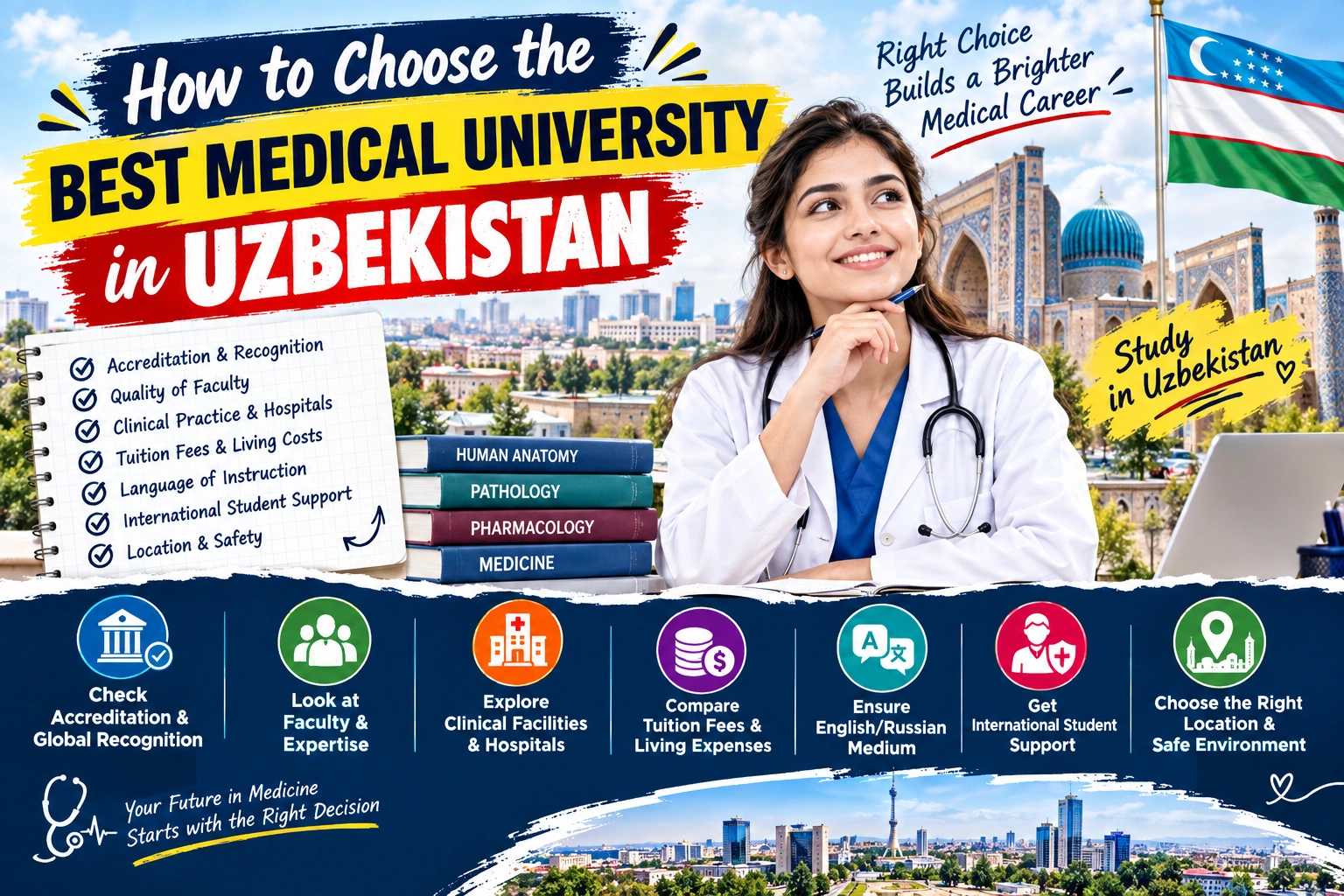
Every university brochure seems to say the same things: English-medium classes, modern laboratories, experienced faculty, recognised degree, excellent hospital exposure. After reading five brochures, most parents are more confused than when they started. Choosing a university for MBBS in Uzbekistan requires a slower, evidence-based comparison. The cheapest college may not offer the right course structure. The most famous name may have a very large international batch. And a university listed in an international directory may still require separate checks for Indian registration eligibility. So, what should you actually examine? Let’s start with the part that matters six years later.
Is the medical programme really six years? Don’t answer this from a consultant’s fee chart. Ask the university for an official curriculum showing the number of academic semesters, total teaching months, clinical rotations, examinations, and internship. Some courses may be advertised as five years plus one year of internship, while others use different academic descriptions. Indian students must verify whether the programme meets the requirements applicable to foreign medical graduates. The National Medical Commission sets conditions related to course duration, compulsory subjects, English-medium instruction, clinical training, internship, and eligibility for medical registration in the country awarding the degree.
Get written answers to these questions:
What is the exact degree title?
How many months of academic study are included?
Is the internship part of the advertised duration?
Where is the internship completed?
Does the programme permit graduates to pursue local registration?
Are all subjects and rotations completed in Uzbekistan?
Which institution awards the final qualification?
A six-year label looks reassuring. The structure behind it is what counts.
Recognition isn’t a single tick mark. A university must be legally authorised to operate, and the specific medical programme should hold the required local accreditation. Start by checking the institution with the relevant higher-education and health authorities in Uzbekistan. Then confirm whether the medical school appears in the World Directory of Medical Schools. WDOMS is a useful directory, but it explicitly states that inclusion doesn’t itself constitute recognition, accreditation, or endorsement. You may also encounter the phrase “WHO-approved university.” The World Health Organization works on global public health and doesn’t issue the kind of individual university approval that automatically guarantees Indian registration. Honestly, a brochure displaying NMC, WHO, and WDOMS logos isn’t enough. Ask for official programme documents. Logos are easy. Compliance takes proof.
Uzbekistan has several medical institutions that international students regularly research. Commonly considered names include Samarkand State Medical University, Bukhara State Medical Institute, Andijan State Medical University, and medical institutions or programmes based in Tashkent. Names and institutional structures can change due to mergers, reorganisations, or upgrades. For example, an institute may later receive university status. Always check the exact legal name that will appear on the admission letter, academic transcript, and final degree.
A useful initial comparison may look like this:
University factor | What students should investigate |
History | Years of medical teaching and graduate batches |
Ownership | Public or private institution |
English programme | Start year and number of completed international batches |
Clinical hospitals | Names, departments, and patient access |
International intake | Batch size and student-to-faculty interaction |
City | Rent, transport, climate, and travel connectivity |
Tuition | Official annual fee and revision policy |
Internship | Duration, location, and documentation |
An older university may have a more established hospital network. A newer institution may offer smaller classes or better-maintained facilities. Neither is automatically superior. Evidence first.
Here’s a detail many students discover late: English-medium lectures don’t mean English-speaking patients. Selected universities offer English-taught medical programmes for international students. Still, Uzbek and Russian are widely used during daily life and hospital interactions. A student may understand a professor’s explanation but struggle to ask a patient where the pain started.
Before selecting MBBS in Uzbekistan, confirm the language used in:
Lectures
Laboratory sessions
Oral examinations
Written examinations
Hospital case discussions
Clinical records
Internship assessments
Ask whether Uzbek or Russian classes are included in the curriculum and whether they teach medical vocabulary. Basic patient communication should be learned before clinical postings, not during the first ward examination. “You’ll never need the local language” sounds convenient. It rarely sounds realistic.
A large hospital building tells you very little about what international students are permitted to do inside it. Ask when bedside postings begin, how often students visit hospitals, and how many learners are assigned to each clinical unit. Find out whether students take histories, perform supervised examinations, present cases, interpret investigations, and observe permitted procedures.
Speak with senior students and ask direct questions:
Are clinical rotations conducted regularly?
How many students stand around one patient?
Do teachers explain cases in English?
Are international students allowed to examine patients?
How is the language barrier handled?
Do students maintain clinical logbooks?
Which departments offer the best and weakest exposure?
A university with busy teaching hospitals and smaller clinical groups may offer better practical learning than one promoting only laboratory equipment. Medical education isn’t a campus tour. Patients matter.
I’ve noticed that families compare first-year packages, although later-year charges are what usually disturb the budget. Tuition for MBBS in Uzbekistan may broadly range from USD 3,000 to USD 5,500 per year at many public institutions, though specific programmes can cost more. Hostel charges may fall around USD 500–1,200 annually. Food and everyday living may require approximately USD 150–300 per month, depending on the city and lifestyle.
Expense | Approximate range |
Annual tuition | USD 3,000–5,500 |
Hostel per year | USD 500–1,200 |
Monthly food and living | USD 150–300 |
Insurance and medical tests | Varies |
Visa and registration | Varies |
Flights | Depends on route and season |
Books and initial setup | USD 200–600 approximately |
A six-year total may reach roughly ₹22–38 lakh or more after tuition, accommodation, food, travel, insurance, registration, exchange-rate movement, and personal spending. These are planning estimates, not official quotations. Request a university-issued fee schedule covering every year. Check application charges, laboratory fees, examinations, visa renewal, hostel deposit, medical insurance, mess, documentation, and consultancy services. Fees low. Very low, sometimes. But every exclusion deserves attention.
Tashkent, Samarkand, Bukhara, and Andijan offer different student experiences. Tashkent generally provides broader transport, international connectivity, shopping, and accommodation choices, but living costs can be higher. Samarkand and Bukhara offer established student communities and may feel more manageable in size. Andijan can be quieter and potentially less expensive.
City choice affects:
Hostel and private rental costs
Distance between campus and hospital
Availability of Indian food
Flight and railway connections
Climate and air quality
Local-language exposure
Part-time support services
Access to coaching or student communities
Don’t choose a university simply because its city appears beautiful online. A daily 60-minute commute to the teaching hospital becomes tiring quite quickly.
More Indian students can make adjustment easier. There may be Indian mess facilities, familiar festivals, shared study resources, and seniors who understand NEET and FMGE-related concerns. Too many students, though, can create crowded lectures and clinical groups. This is particularly important during bedside postings, where 20 students cannot all examine one patient properly. Ask for the approximate intake in the English-medium medical programme, not the university’s total enrolment. Also ask how students are divided into practical and clinical groups. A batch of 300 may be divided efficiently. A batch of 100 may not be. The organisation matters more than the headline number.
One impressive professor’s profile doesn’t describe an entire medical course. Students need competent teaching across anatomy, physiology, pathology, pharmacology, medicine, surgery, paediatrics, obstetrics, and every other required subject. Request access to a sample lecture or online orientation. Ask current students whether faculty members teach in understandable English, answer questions, and conduct regular assessments. Find out whether the English programme uses permanent university faculty or visiting teachers who change frequently. Signs of a dependable academic system include scheduled classes, documented attendance, regular practical sessions, transparent examinations, accessible teachers, and a functioning student grievance process. Perfect teaching everywhere? Unlikely. Consistent teaching is the more sensible target.
NEET is not just an Indian college entrance issue. Indian students seeking a primary medical qualification abroad generally need to qualify NEET-UG under applicable regulations if they plan to pursue registration in India. The category-wise qualifying score changes each year, so applicants should use the official NEET portal for current results, cutoffs, and instructions. Don’t confuse the qualifying cutoff with the much higher score usually required for an Indian government medical seat. Basic academic eligibility commonly includes Class 12 Physics, Chemistry, Biology or Biotechnology, and English. General-category candidates usually require 50% PCB, while eligible reserved-category applicants generally require 40%, subject to current rules. Keep the NEET scorecard for the entire foreign course. Store it on two devices and in secure online storage. Old documents have a habit of becoming urgent years later.
The best university for an Indian student isn’t simply the one with the nicest hostel. It should provide the academic and clinical foundation required for the licensing pathway after graduation. FMGE remains relevant for eligible foreign medical graduates in 2026. NExT regulations have been notified, though implementation developments should be followed through official NMC announcements. A student beginning a six-year programme now can’t safely assume which exact examination will apply at graduation.
Ask whether the university provides:
Access to standard English medical textbooks
Regular clinical case discussions
Indian student academic support
Suitable library and digital resources
Time for independent licensing-exam preparation
Records of clinical rotations and internship
Optional FMGE-oriented classes, if available
Don’t choose purely from an advertised FMGE success rate unless the data shows the batch, examination session, number of candidates, and original source. Percentages without context can mislead.
A comfortable living arrangement won’t replace academic quality, but a poor one can damage concentration. Ask for current hostel photographs or a live video. Check the number of students per room, heating, water, Wi-Fi, electricity, kitchen access, laundry, security, curfew, and distance from campus. Find out whether students can move into private accommodation after the first year. Indian mess facilities are available near several popular universities, though charges and quality vary. Vegetarian students should confirm actual meal arrangements. “Vegetarian option available” can sometimes mean bread and salad. For daily safety, students should use registered transport, protect passports and immigration documents, avoid carrying large amounts of cash, and follow instructions from the university and Indian Embassy. The Embassy of India in Tashkent also provides an admission guide for students considering Uzbek medical institutions, including advice to confirm that the university offers instruction in English.
Stop if someone demands urgent full payment into a personal account. That isn’t a small warning. A proper process generally includes university selection, document submission, academic review, offer-letter verification, authorised fee payment, invitation processing, visa application, and registration after arrival. The offer letter should mention the student’s name, programme, teaching medium, intake, duration, fee, and reporting date. Confirm it using the university’s official email address.
Typical documents may include:
Passport
Class 10 and 12 records
NEET scorecard
Passport-size photographs
Medical fitness certificate
HIV test report, where required
Birth certificate
Completed application form
Police clearance, if requested
Applications commonly begin during spring or early summer for an autumn intake, often continuing through August or September. Exact dates differ by institution. Earlier application gives more time for corrections, invitation processing, visa formalities, and hostel allocation.
Some warning signs are obvious. Others sound reassuring until you examine them.
Be cautious if an agent or university representative claims:
Guaranteed medical registration in India
No need to qualify NEET
No local language is needed in hospitals
A WDOMS listing guarantees eligibility
The internship can be arranged later anywhere
The full fee must be paid immediately
The university can’t provide its clinical hospital list
Course duration is different in the brochure and offer letter
If basic questions produce vague answers, don’t assume things will become clearer after arrival. Usually, they don’t.
Before paying for MBBS in Uzbekistan, give every shortlisted institution a score out of five for the following areas:
Selection factor | Suggested priority |
NMC-related course compliance | Very high |
Internship and local licensing | Very high |
Clinical training | Very high |
English-medium teaching | High |
Faculty and batch size | High |
Total six-year cost | High |
Hostel and city | Medium |
Indian student community | Medium |
Promotional rankings | Low |
The best university is the one that performs well across the high-priority areas and fits the family’s budget. Not necessarily the cheapest. Not necessarily the most advertised.
There is no universal answer. Samarkand, Bukhara, Andijan, and institutions in Tashkent may offer different strengths. Compare the exact programme, clinical hospitals, internship, teaching language, fees, and student feedback.
Indian applicants seeking foreign medical education and intending to pursue registration in India generally need to qualify NEET under current regulations.
Tuition commonly falls around USD 3,000–5,500 annually at many institutions, though actual fees may be higher or lower. Obtain an official 2026 quotation directly from the university.
No. WDOMS listing doesn’t itself guarantee accreditation, NMC compliance, or registration eligibility. Students must verify the complete medical programme and internship separately.
Selected institutions offer English-medium academic programmes, but students usually need Uzbek or Russian during clinical postings and daily life.
Eligible graduates may pursue the licensing and registration pathway applicable in India if their admission, qualification, course duration, internship, and clinical training meet current NMC requirements.
A university should survive detailed questioning. Ask about the curriculum, internship, hospital rotations, faculty, batch size, language, local licence eligibility, and every compulsory charge. Then verify the answers. Speak with senior students. Read official documents. Compare the complete six-year cost. Before finalising MBBS in Uzbekistan, check whether the chosen university fits both your current budget and your future licensing plans. Admission is one day. The course takes years. Choose for the years.