
Published at : 2026-04-21 06:56:00 | Views: 2,044
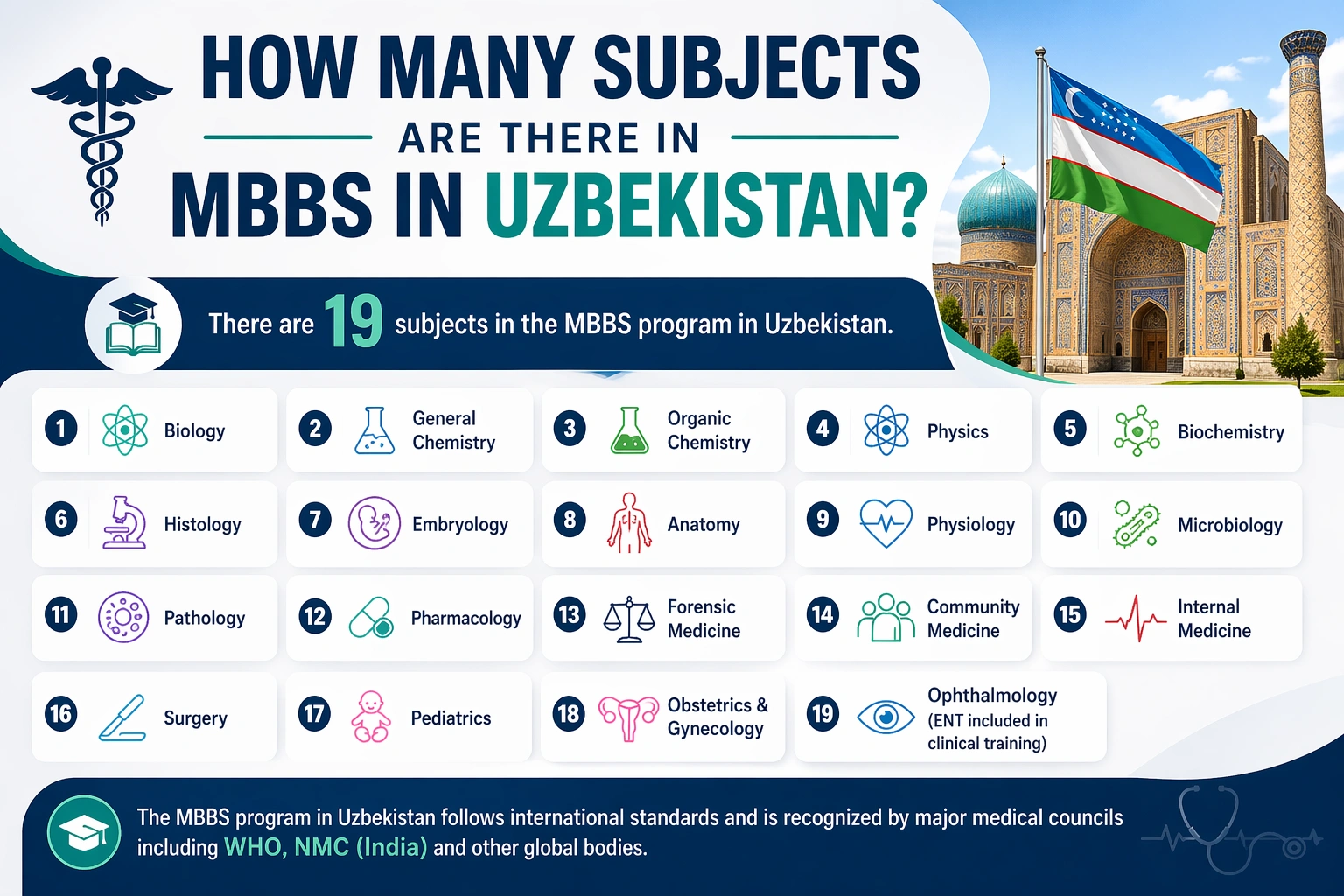
Studying MBBS abroad has become a trending wave of choice among Indian students, which looks promising in that country and one of them is Uzbekistan because it is cheaper than many other countries where quality education can be accessed. When you apply for MBBS in Uzbekistan, one question that always comes up is How many subjects are there in the MBBS syllabus?
The MBBS curriculum is regulated and is provisioned according to the international medical education standards (IMED) and would usually take 5 to 6 years including clinical training. The course consists of a pre-clinical, para-clinical, and clinical component covering all the subjects necessary for qualifying as a doctor.
While subjects may vary ever so slightly from one university to the next, there is no universal number. But on average, students study for 15 to 20 major scientific fields over the years of the course.
These subjects are apportioned over various academic years so as to take students from basic sciences to advanced clinical practice.
The first few years will lay strong ground work in medical science. Key subjects include:
Anatomy
Physiology
Biochemistry
Histology
Medical Biology
These papers help students gain an understanding of the anatomy and physiology of the human body prior to moving onto clinical subjects.
Students start learning about diseases and how they work during this stage. Subjects include:
Pathology
Microbiology
Pharmacology
Forensic Medicine
Community Medicine
These are the subjects that help to fill in the gap between theoretical knowledge and application of clinical practice.
And the last few years are all practical training and working with patients in hospitals. Major subjects include:
General Medicine
General Surgery
Pediatrics
Obstetrics and Gynecology
Orthopedics
Ophthalmology
ENT (Ear, Nose, Throat)
Psychiatry
Dermatology
Students are taught through coursework but also have clinical rotations and internships as well as hospital training to gain actual medical experience.
Medical universities in the Republic of Uzbekistan continued to be international in accordance with a number of global organizations. Its World Health Organization recognition guarantees world acceptance of the level.
Furthermore, such universities also feature in the World Directory of Medical Schools, a necessity to ensure that students seeking international post graduate education or practice are officially recognised.
Indian students need to be recognised by the National Medical Commission for their qualification, so that they can appear for licensing exams in India — like FMGE/NExT as as compared with international students.
As compared with many other well-known destinations such as MBBS in Georgia, the structure of subjects is almost identical. As in both countries followed the internationally accepted curriculum divided into pre-clinical, para-clinical and clinical stages.
But Uzbekistan is unique with regards to:
Lower tuition fees
Affordable cost of living
English-medium programs
Increasing number of NMC-approved universities
MBBS syllabus and subjects in Uzbekistan that is normally includes:
5 years of academic study
1 Year (clinical training) Intern
Interns get to spend time pushing their practical knowledge through immersing themselves in real hospital experiences at multiple departments as part of their internship.
Covers 15–20 core medical subjects
Follows international curriculum standards
Includes practical and clinical exposure
Focus on theory and practical learning
Prepares students to sit medical licensing exams across the globe
The number of subjects is certainly an important part, but students must also answer the following:
University recognition and accreditation
Medium of instruction (prefer English)
Clinical exposure opportunities
FMGE/NExT preparation support
It is equally important to comprehend the syllabus, as it is to choose the right University.
Wide-ranging subjects in the MBBS curriculum of Uzbekistan cover approximately 15 to 20 subjects including phase-wise medical education. The course prepares medical students to become competent professionals from basic sciences and advance training on clinical practices.
So, if you are looking to study abroad, exploring the options like MBBS in Uzbekistan or MBBS in Georgia would be beneficial as well as cost effective and globally recognized medical education.
University Recognition: It is crucial to check the recognition of universities through institutions such as the World Health Organization and National Medical Commission prior to your final selection.