
Published at : 2026-08-04 18:33:00 | Views: 2,068
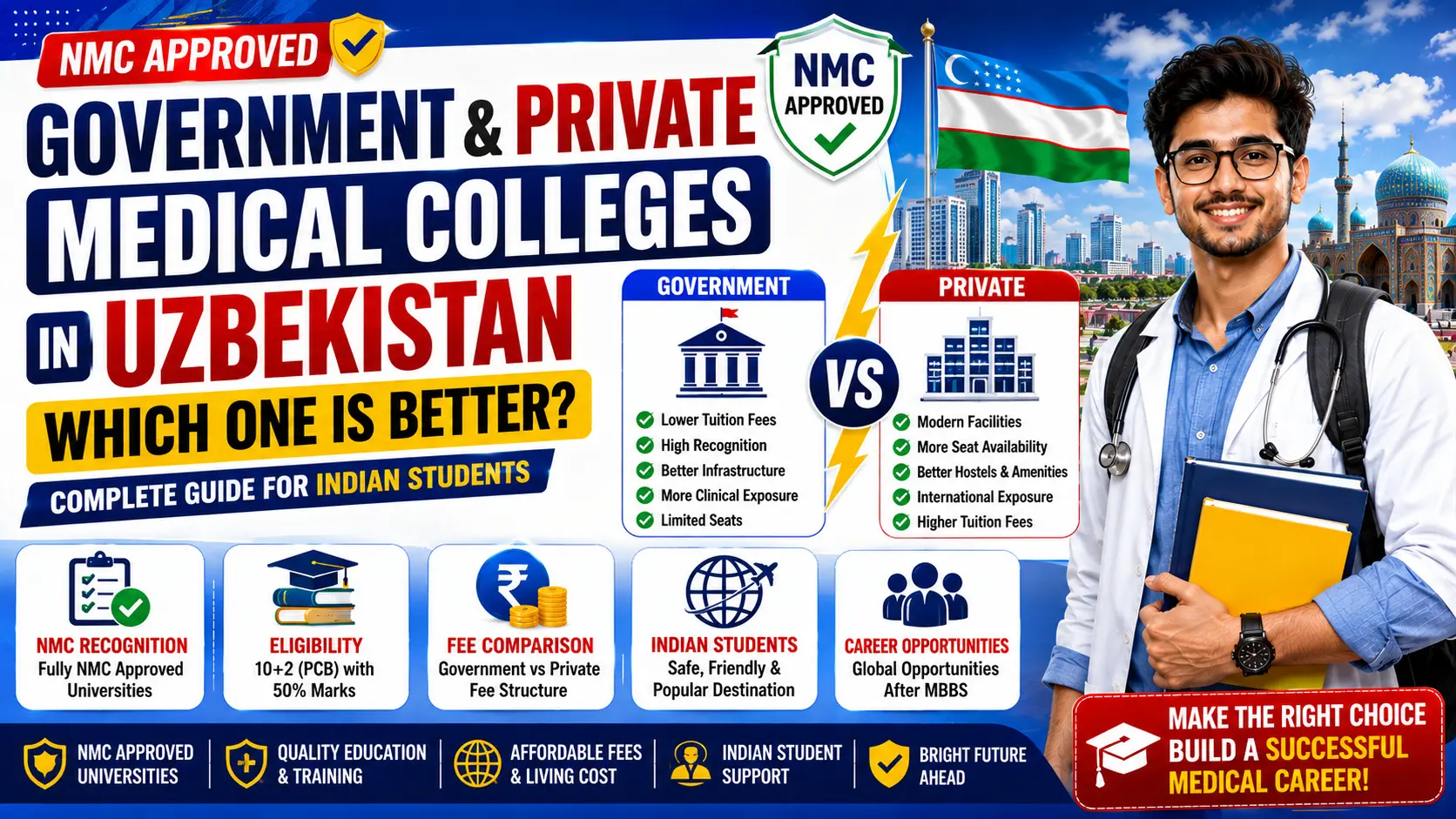
Ask five different education consultants which Uzbekistan medical college is “the best,” and you’ll likely get five different answers – usually directed to whichever university offers them the highest commission. The one comparison that actually matters and rarely gets a straight answer is much simpler: should you go for a government university or a private one?
You will find NMC-approved medical universities in both government and private categories. Both seem to make it onto each consultant’s shortlist. Clearly, there is a difference, and choosing the right medical university is a more subjective process. Here is a comparison, based on fact.
Government medical universities in Uzbekistan have a long history of providing education, low tuition, and higher institutional prestige. For students who prioritize affordability and recognition, government medical universities are the better choice. Students who prefer a more personalized learning experience should consider the modern and flexible admission policy of private medical universities. Both government and private medical universities secure NMC-approval and are listed by the WHO. Thus, you should be considering the “government/private” distinction only after you have made a budget consideration and decided on your learning preferences for MBBS in Uzbekistan.
There are a dozen or so Uzbek state funded medical colleges, and fewer private medical colleges, where Indian students can pursue an English Medium MBBS degree (which they call MD). Uzbekistan’s healthcare education system is in accordance with the internationally accepted compulsory teaching hour standards. As a result, Indian students constitute one of the largest international student populations in both government as well as private universities pursuing MBBS in Uzbekistan.
Should have attained the age of 17 by 31st December of the year of admission.
Must have achieved a minimum of 50% aggregate marks (40% for reserved categories) in the 10+2grade with PCB.
Has taken & cleared NEET examination irrespective of choosing a government medical college or a private medical college.
Submission of medical fitness certificate at the time of visa application.
Confirmation of NEET scores and cutoffs are valid for both government and private medical colleges. Hence, always check it on the NTA NEET official site before making any selection.
Although the overall procedure is similar for government and private medical colleges, the private medical colleges’ procedures are comparatively faster.
Selection of universities based on Government/Private option, Fees, and location.
Submission of documents such as certificates of Highest educational qualification + NEET score + Passport + photographs.
Receiving of the admission/invitation letter is slightly faster in private medical colleges due to their quick internal approvals.
Application for a student visa has to be done through the embassy or the university’s visa desk.
Confirmation fee is to be payed in order to block the admission.
Registration and orientation is to be done upon arrival.
Some governments only allow students to apply for admission at government universities during certain periods, while other institutes restrict only private universities. They offer what is known as 'rolling admissions.'
CATEGORIES | APPROX. ANNUAL TUITION | APPROX. TOTAL 6-YEAR COST |
Government Universities (such as Tashkent Medical Academy and Samarkand State Medical University) | $2,500-$4,000 | $16-24 Lakhs |
Private Universities (such as Kimyo International University and others like it) | $3,500-$5,500 | $20-28 Lakhs |
Factor | Government Universities | Private Universities |
Institutional History | Established many decades ago | Younger |
Class Sizes | Larger | Smaller |
Infrastructure | Older, functional | Newer, more modern |
Admission Flexibility | Only at defined periods | More flexible |
Fee Structure | Lower | Higher |
Tashkent Medical Academy (one of the oldest and most reputable medical schools in Central Asia)
Samarkand State Medical University (a school that has a solid history of clinical training since 1930)
Bukhara State Medical Institute (a university with a strong academic program that is housed in a historic setting)
Andijan State Medical Institute (a school that has a significant presence of Indian students and a strong basic sciences foundation)
Kimyo International University (a school with a modern system of education that is internationally aligned)
A small number of private institutes that are now advancing NMC-endorsed MBBS programs are the only other options besides government schools.
Students who want to study MBBS in Uzbekistan
Lower Tuition
Older universities have large reputable alumni networks.
Strong clinical and research history.
Labels recognized by the World Health Organization and National Medical Council.
Newer labs and accommodation may be present.
Smaller class sizes means more faculty focus.
More flexible admission and fees schedules.
More collaborations internationally and a modern curriculum.
Government run universities can have very large class sizes which leads to less faculty focus.
Private medical universities charge a higher tuition than government universities.
More NMC approved universities are government run, so there are more choices if you wish to attend university.
Regardless of which university category you chose, in recent years the national average of FMGE/NExT has been less than 20% in recent years, so whether you chose a government or private university, it won't affect your chances of a license, as long as you study consistently while pursuing study MBBS in Uzbekistan.
Regulatory advisories about clinical practice and licensing are changes frequently so always check the National Medical Commission website for the latest before going to any university.
Once you graduate, there are little to no differences in the career pathways you take whether you've government or private schooling.
Clear FMGE/NExT to practice medicine in India.
Pursue MD/MS specializations in India or abroad.
Attempt the USMLE to practice in USA.
You can work in any country that has your degree in their WDOMS.
Employers and licensing bodies will not care about whether your university is private or public when considering your application. What they will care about is whether your university has World Health Organization (WHO) and NMC (National Medical Commission) recognition while completing Uzbekistan MBBS, medical universities in Uzbekistan, MBBS admission in Uzbekistan, Uzbekistan medical colleges, MBBS course in Uzbekistan, MBBS colleges in Uzbekistan, study medicine in Uzbekistan, and medical education in Uzbekistan.
Not necessarily. There are advantages to both. Government medical colleges would offer a lower fee and long-standing institutions, whereas private medical colleges would offer a shorter batch size and state of the art facilities. As long as they are NMC approved, either would an equally valid option.
Some are, but government medical universities would have a much larger number on that list. Make sure to confirm NMC approval for any private medical universities that you are thinking of applying to.
Government medical universities would be the cheaper option.
No, it will not make a difference. As long as you have the knowledge to answer questions about medicine, that will be the determining factor and not your college type.
No, all Indian students need to take the NEET in order to get admissions to any medical university (whether government or private) in Uzbekistan in order to practice medicine in India.
I wouldn't say one is definitively better between governmental and private medical colleges in Uzbekistan. It depends largely on what you are optimizing for. If you are more concerned with the financial side and the institution's history, governmental universities could be the right choice. If you are more flexible and happy with smaller class sizes and newer infrastructure, a private university may be what you're looking for, as long as you can afford it. The only hard line on all of this, no matter what you choose, is confirming NMC and WHO accreditation for all of your fees. This is the right path to a respectable and legitimate medical career that will be the end goal of whatever you choose.