
Published at : 2026-06-11 13:28:00 | Views: 2,064
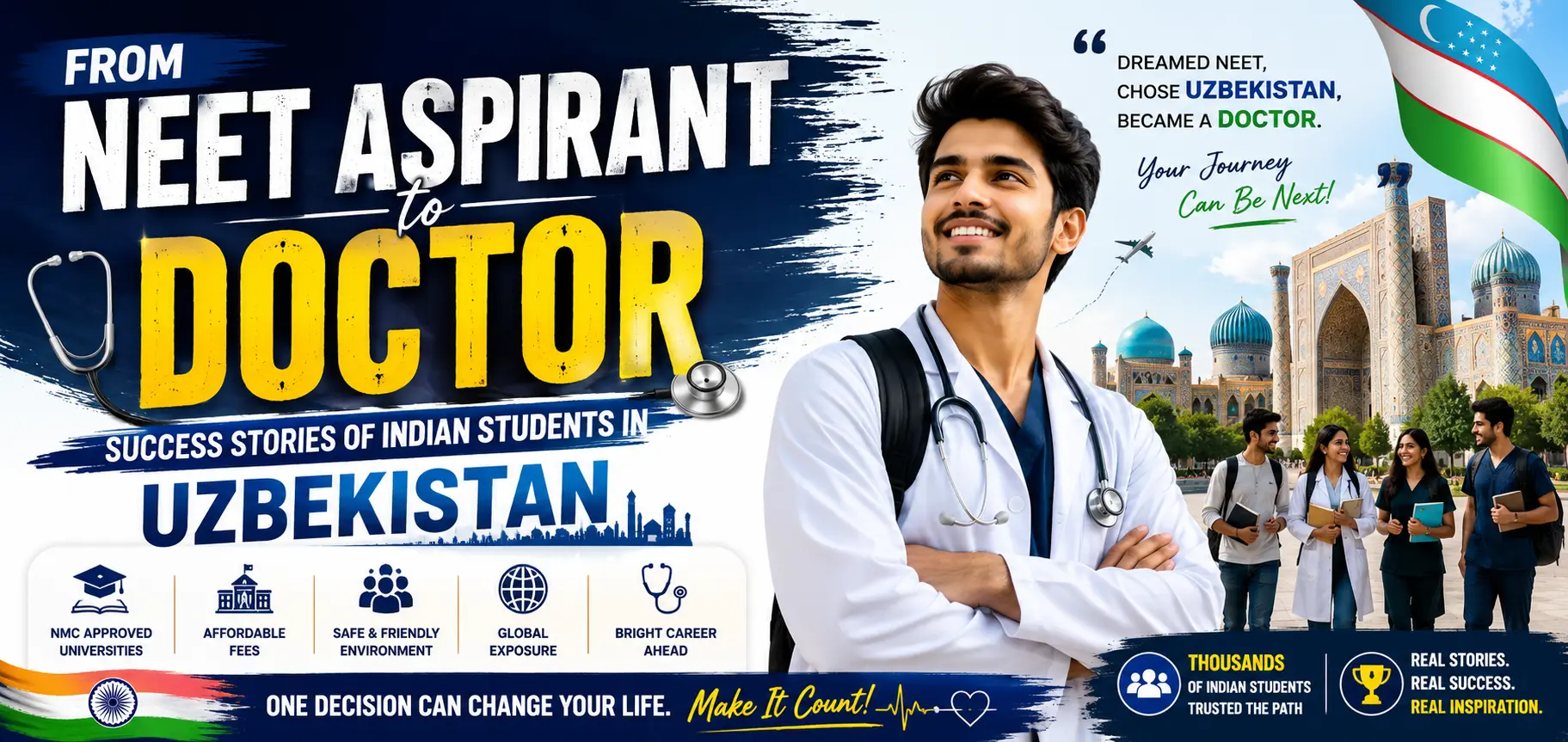
Call it a passion or a lifelong dream, lakhs of Indian students yearn to become doctors each year. They meticulously plan their entire year to qualify for the NEET to gain admission to Government Medical Colleges. Even after all this, a vast majority of students fail to gain admission due to the stiff competition and limited resources.
In these situations, students are left with the option to study medicine abroad. Among these, MBBS in Uzbekistan has become a highly preferred option for Indian students. Uzbekistan provides modern infrastructure, affordable tuition, and English programs with internationally recognized medical education. Every story of admission has a story of its own. This article shows the transformation of Indian students from NEET aspirants to medical professionals through MBBS in Uzbekistan.
The Reality of Medical Admissions in India
India is one of the leading countries with a large population of NEET candidates. While a large number of students qualify for NEET, very few are able to secure a Government MBBS seat. The major obstacles include:
Less government medical seats
Higher cutoff scores
Rising Private medical college fees
Thriving competition
Family financial burden
Because of this, each year thousands of capable students look for options abroad. This is where studying MBBS In Uzbekistan is a good alternate option.
Success Story 1: Small-Town Dreams, Now Overseas
ONE from UP is a budding doctor. After scoring good marks in NEET, he did not get any government college seats. He thought he would have to forfeit his dream, as private medical fees were too high.
Then he found out about MBBS in Uzbekistan. After little research about the recognition of medical degrees, language, and safety concerns, and after confirming university recognition in the World Directory of Medical Schools (WDOMS) and the advisory of the National Medical Commission (NMC), he was ready to fulfill his dreams.
Now Rahul is undergoing his clinical and preparatory training for his licensing exams. His example proves that just because there are no opportunities in India, it does not mean you cannot have a medical career.
Success Story 2: Money is no Object
Priya and her middle-class family from Rajasthan faced a major challenge after qualifying in NEET. Getting private MBBS college seats means countless lakhs of rupees.
So they started looking for alternate options. After thorough evaluation, she decided to study in Uzbekistan because of:
Low budget course
Affordable English courses
Globally accredited colleges
Good atmosphere
Priya was anxious in the beginning, but she adapted to the situation quickly. The teachers were helpful, the labs were advanced, and the number of Indian students was increasing.
Now, she has become a role model for many students, as she demonstrates that being a doctor is possible without money being a hurdle.
Success Story 3: Language Barriers
Language is one of the greatest obstacles for Indian students. One of the things that Aman from Delhi was nervous about was that he didn't know how to speak Russian or Uzbek before moving abroad, but he soon realized that all of the lectures, practicals, and exams, which were done in English, were part of the English medium medical program.
He indicated that knowing how to speak the local language, which he learned during a language course that was offered by the university to help him communicate with patients, was also useful during clinical practice. He also highlights that many students face the same thing while studying MBBS in Uzbekistan: they do not need to know how to speak the Russian or Uzbek languages.
Success Story 4: Building Global Career Opportunities
Neha's goal has always been to become a doctor and work in other countries. After enrolling in a medical university in Uzbekistan, she got the opportunity to work with:
A Wide Variety of Patients
Advanced Medical Equipment
Modern Medical Teaching and Training
International Standard Medical Training
Clinical Training
She also got to know the international licensing system. Graduates from foreign universities grounded in international recognition can gain eligibility to the following examinations:
NEXT/FMGE in India
USMLE in the USA
PLAB in the UK
All these options inspired her to concentrate on pursuing a career in global medicine. Currently, she is highly focused on her career and is preparing for her post-graduate studies. She is of the opinion that pursuing MBBS in Uzbekistan has been one of the best decisions she has made in her life.
There are many reasons why MBBS in Uzbekistan for Indian students is popular among Indian students.
One of the main attractions is affordability. Uzbekistan has considerably lower fees when compared to private medical institutes in India.
There are no considerable language barriers and students can pursue medical education in English.
There are many universities that are listed in WDOMS and are in sync with global standards of medical education.
There are many communities that assist Indian students to adapt quicker and more smoothly.
All medical universities offer hospital-based clinical education that aid students in learning valuable skills.
Success abroad is heavily dependent on selecting the right institution. Students should check:
University status
Availability of clinical education
Internship Opportunities
Faculty
Support for International Students
Helpful websites are:
The WHO helps students by verifying medical education systems and providing valuable information on global health care. The official website of the World Health Organization.
Medical students can check medical school listings here WDOMS
Indian students can check what the new regulations are here. Proper research before admission plays a significant role in ensuring future success NMC
Great stories of accomplishment involve overcoming obstacles. Among the obstacles faced by Indian students studying in Uzbekistan are:
Moving to a new country comes with adjusting to new ways of living.
Being away from family during the first few months can be emotionally draining.
The process of studying medicine is time and labor intensive in all countries.
Students may need to learn a few basic local language skills while training in the hospital. Fortunately, most students conquer these obstacles with sheer will power and effort.
There are several critical lessons that the stories of the Indian students in Uzbekistan teach us:
Losing a government seat for studying medicine is not an end to fighting for the goal.
Studying in other countries can be a legally acceptable pathway to becoming a physician.
The region of the world where the medical degree is obtained does not alter the essential requirement for dedication to the field of medicine.
Today, medical graduates have more promising opportunities to practice medicine in countries all over the world. The prospects are bright for Indian students who choose to study MBBS in Uzbekistan.
This trend can be attributed to a variety of elements:
Better educational infrastructure
Higher enrollment rates of international students
Better clinical training facilities
Higher levels of understanding in Indian families
Improved global connectivity
With more graduates returning with positive reviews, Uzbekistan will likely remain a popular country for abroad medical studies.
Conclusion
The road from NEET to becoming a doctor is rarely a smooth one. Though a small fraction of students manage to get admissions in India, the majority of students have to take alternative routes for fulfilling their dreams.The journeys of Indian students who went for MBBS in Uzbekistan serve as an inspiration to students that barriers of finances, admission obstructions, and study abroad uncertainties can be removed through sheer will and the right choices at the right time.
For many aspiring doctors, MBBS in Uzbekistan for Indian students is beyond an educational venture, it is a tool for realizing their dreams.For many former aspiring doctors, the road to success is lined by sacrifice and perseverance to achieve a goal, which includes overcoming less than optimal finances and cultural adjustments.The world is witnessing the path that many aspiring doctors from Uzbekistan have taken, and it bears the message that: