
Published at : 2026-06-11 13:32:00 | Views: 2,783
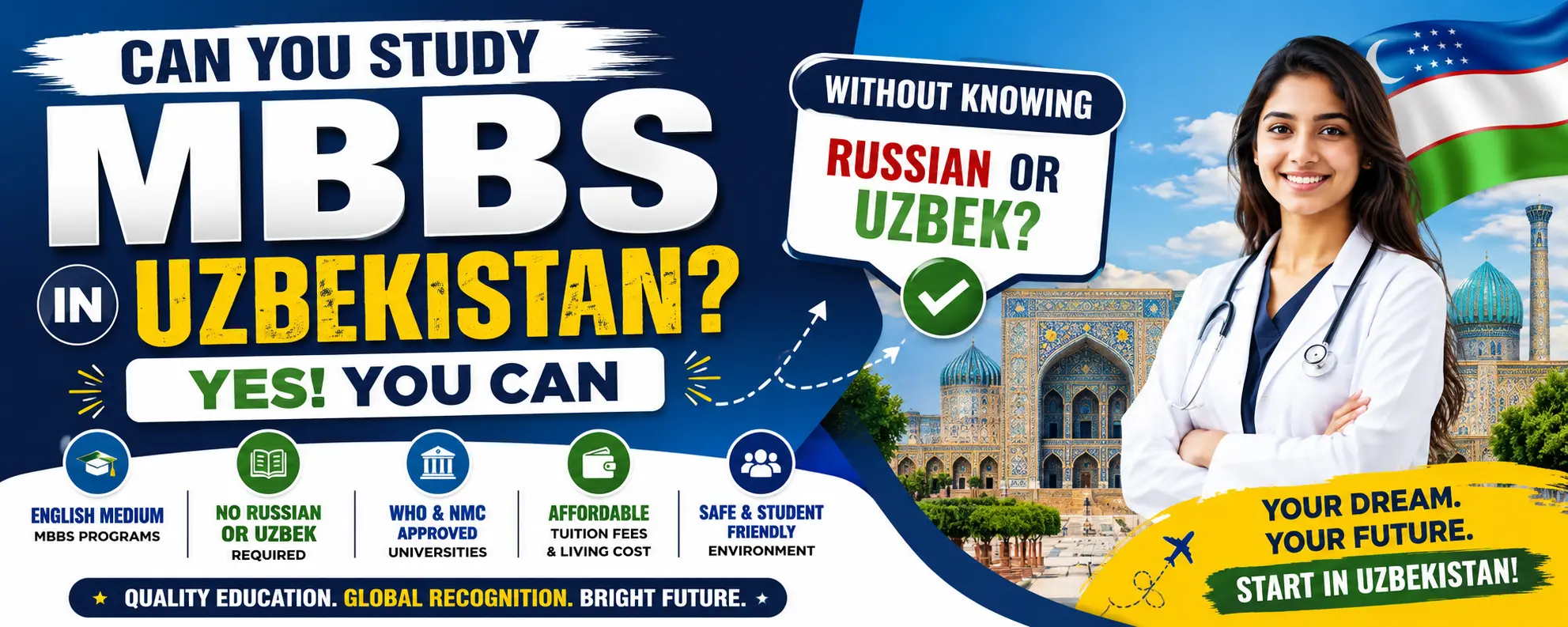
Unfortunately, students looking to get their MBBS in Uzbekistan are right to be concerned about language issues because of Uzbekistan’s location in Central Asia. Potential medical students, therefore, are wondering if they are going to have to learn Russian or Uzbek, the two main languages in Uzbekistan, before applying to medical schools there. Fortunately, most of the prominent medical schools in Uzbekistan have English-taught MBBS programs and do not require the students to have prior knowledge of either of the two languages.
There are some areas of medical education where knowing the language may be useful. Students should understand the place of language in education, everyday life, and in the practice of medicine, in order to be able to make the right decisions about going to study overseas. This guide will help students understand if they can study their MBBS in Uzbekistan without knowing Russian or Uzbek, what obstacles they will face, and how the universities help the international medical students.
Uzbekistan is a multilingual society. The official language is Uzbek, while Russian is the dominant language of communication in business, medicine, education, and everyday life. For the international student, this raises the question whether language will pose a barrier in obtaining an MBBS degree?
The answer is dependent on which phase of education is being referred to.
Most of the universities offering MBBS in Uzbekistan for Indian students have, for the most part, English-based programs which are specifically designed for foreign students and, thus, academic learning will not pose a required lack of proficiency in the local languages. As a result, students can lecture, study medical subjects, do exams, and do assignments in English.
Yes.
Numerous accredited medical universities in Uzbekistan have English MBBS programs for overseas students. Academically active in English.
Includes:
Lectures
Laboratory
Medical books
Study resources
Assessments
Exams
E-learning resources
This is aimed at students from India and other countries for easy assimilation to the curriculum. English-medium instruction is one of the main factors that have contributed to making overseas MBBS in Uzbekistan popular.
MBBS in Uzbekistan or programs internationally have been on the rise, and so have the number of students immigrating to Uzbekistan from:
India
Nepal
Bangladesh
Sri Lanka
Pakistan
Nations in Africa
Middle Eastern countries
University medical English programs have been a way for universities to allow large numbers of medical students to enroll, while still keeping their programs at a high standard. This has greatly increased the number of students from India looking for quality and low cost MBBS programs.
No.
Most universities do not require students to take a Russian or Uzbek language test to gain admission. Typical admission criteria are:
NEET exam (For Indian students)
50% in Physics, Chemistry, Biology (For General Category)
Passport
Academic papers
Application to the University
As for MBBS English programs, speaking Russian or Uzbek are not admission criteria.
This encourages students from various educational backgrounds to apply themselves without the requirement to learn a new language first.
While education is provided in English, the training of a medical professional is beyond the education system. During the clinical years, students spend time in the hospital interacting with genuine patients. This is when the knowledge of Russian or Uzbek is useful.
To develop an understanding of patients’ symptoms, medical doctors need to:
Take a history
Explain a plan
Build rapport
The fact that many of the local patients are Russian or Uzbek speakers means that students may initially have difficulty communicating during clinical placements. This is a known problem, and the medical schools offer help to the international students.
The medical schools of Uzbekistan understand that the international students do not speak the local languages. To overcome the problem, many of the medical schools offer:
Students may receive a preparatory course that includes:
Russian language
Medical vocabulary
Phrases for professional communication
General conversation
May be offered as a:
Taking a history
Medical interviewing
Healthcare communication
Many of the departments offer:
English speaking faculty
Student coordinators
Clinical supervisors
These resources enable the students to gain the confidence to communicate with local patients.
No, for the majority of students. Success in the field of medicine requires:
Understanding of concepts
Study habits
Skills
Clinical reasoning
Preparation for Exams
As the lectures and the study materials are in English, students may attend to the business of learning medicine. Most Indian students find it easy to adapt to the global norms of standardized medical terminology. Medical Subjects:
Anatomy
Physiology
Biochemistry
Pathology
Pharmacology
Surgery
Internal Medicine
are all taught using standard medical terminology. This helps decrease the impact of many language barriers.
Many students have concerns about the ability to communicate when not on campus.
In the beginning, the language differences create minor problems during:
Shopping
Transportation
Food ordering
Asking directions
Since many international students adjust quickly, so will you. This is the result of:
Many cities with medical universities have many international students.
Communication has improved with:
Google Translate
AI-based language
Translation Apps
Senior students support settling and guiding newcomers. Most students are able to learn the language and do simple tasks within a few months.
Even though language skills are not mandatory, there are still many benefits.
Direct patient communication hinges on the ability of students to speak the local language rather than using a translator.
Language skills also help when working in a medical environment.
You can also communicate with the local people and will understand their customs.
In medical internships, students learn and interact with patients a lot.
You will be able to communicate easily and you will gain a lot more from the experience.In summary, even though fluency is a tall order, speaking the local language at a basic level is a lot more beneficial and will help you on your professional medical journey.Students interested in assessment should focus on recognition and compliance, not language, when looking at medical universities abroad. The following may be useful:The World Health Organization provides information on international health and medical education WHOThe World Directory of Medical Schools documents all recognized medical schools WDOMSThe National Medical Commission regulates medical education and Foreign Medical Graduates in India.NMC Indian students intending on pursuing an MBBS in Uzbekistan must ensure that the medical schools they are interested in comply with NMC regulations and are listed in WDOMS.
Reality: Russian proficiency is not a requirement for admission to programs offered in English.
Reality: programs are offered in the medium of English.
Reality: Assessments will be in the medium of English.
Reality: Students will learn the language over the course, Universities provide language training.
Reality: Each year, thousands of Indian students will successfully obtain their MBBS degrees in Uzbekistan.
The following is a helpful tip for those individuals that are considering pursuing their MBBS in Uzbekistan.
Learn basic greetings in Russian or Uzbek
Familiarize Yourself With Common Medical Terminology
Join Student Groups For Guidance
Attend classes that offer support for your language
Practice your language skills with the locals
Practice language skills with language-learning applications
Be present and engaged during clinical rotations
Develop skills for communicating in English
Learn techniques for passing FMGE/NEXT
Develop skills that will help you interact with patients
These steps can help you perform better academically and gain skills that will help you become a better clinician.
Not including language barriers, Indian students still choose Uzbekistan because of its:
Lower cost of education
Availability of English-taught MBBS
MBBS International Student Friendly
Developing Medical Infrastructure
Developing Recognition in International Arena
Safe for Students
Familiar Indian Culture
Availability of Indian restaurants
These reasons are beneficial for students who want an international medical education but want to save costs.
Is it possible to study MBBS in Uzbekistan with no knowledge of the Russian or Uzbek languages?
Yes, Most of the universities that offer MBBS in Uzbekistan have fully established English-taught medical programs for International Students. There is no mandatory requirement for knowledge of the Russian or Uzbek language for admission, and you have the opportunity to complete your studies in English.
However, it is advisable to learn a few skills of the local language during your studies to improve the quality of your clinical practice and interaction with patients as well as your day-to-day experience of living in that country. The universities offer language support to help International Students.For students who are planning to do MBBS in Uzbekistan for Indian Students, the language barrier should not be the main concern. The main focus should be to choose the university that meets the requirements of WHO, WDOMS, and NMC.Considering the correct university and the appropriate dedication to Medical Studies, Study MBBS in Uzbekistan can be a great option for a successful international medical career.