
Published at : 2026-08-05 18:02:00 | Views: 2,051
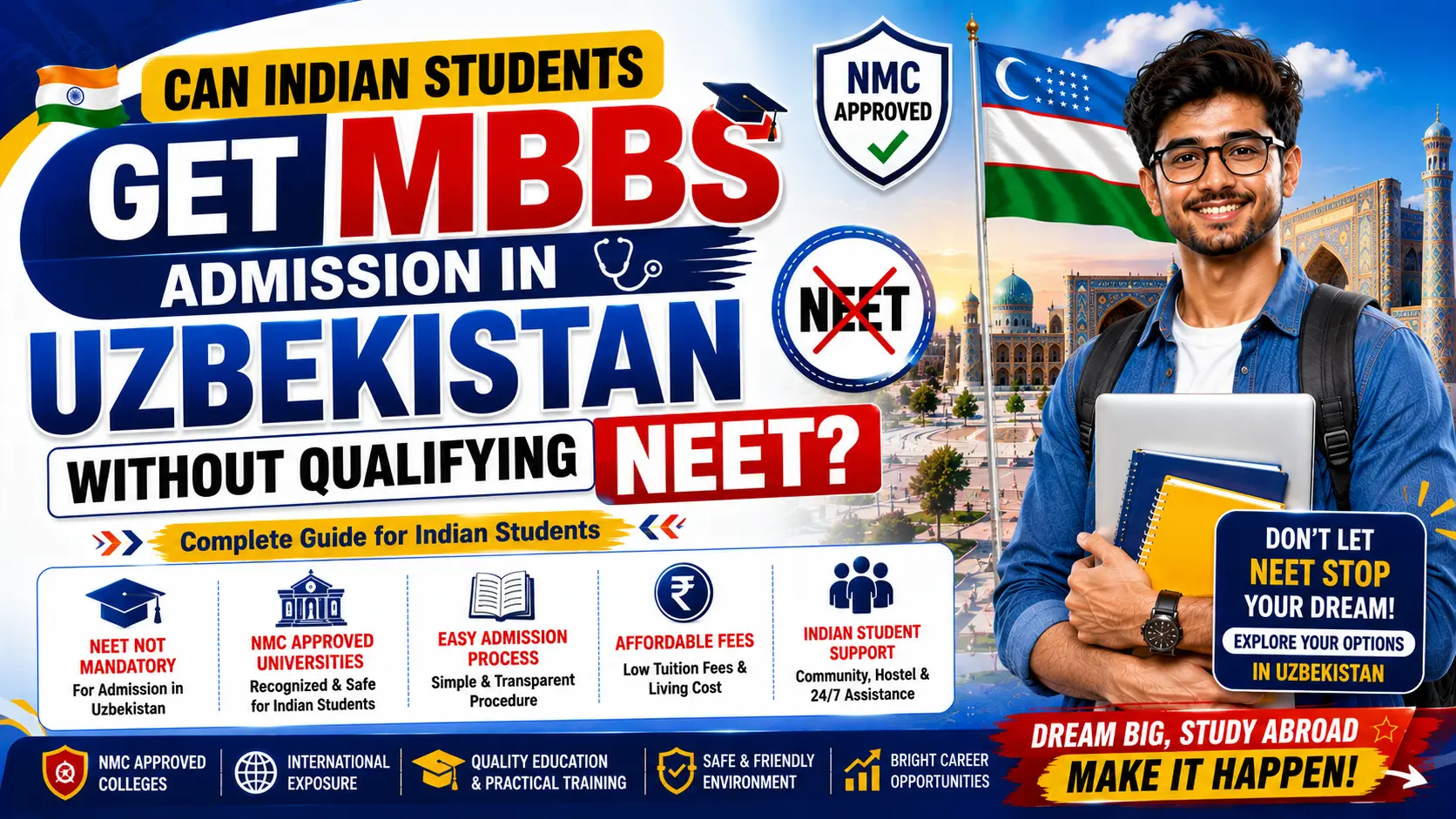
It's pretty evident why many Indians are now considering MBBS in Uzbekistan. It's cost-effective and English-taught, with reputable global universities. And honestly, it's way less financially draining compared to India's several private medical colleges. Every year, thousands of Indian students venture to Uzbekistan for MBBS study.
But here's the question everyone asks: Is NEET really a prerequisite for Indian students to apply to medical schools in Uzbekistan?
To answer that – yes, many universities in Uzbekistan can admit international students without a qualifying score from NEET. However, based on the National Medical Commission's recent directives, Indian students attempting to practice medicine in India must have taken and qualified NEET.
Studying MBBS in Uzbekistan is indeed possible without NEET, but as per the recent NMC regulations, Indian students cannot practice medicine in India unless they qualified the NEET-UG. Hence, it's always recommended that Indian students should do NEET before joining any foreign medical university.
This article covers everything Indian students must know prior to applying to Uzbekistan's medical universities at the start of 2026 – eligibility, fees, admissions, the best universities, advantages and disadvantages, and job prospects.
Well, NEET will only be required if you wish to practice medicine in India.
If you're an Indian student aiming to return to India upon graduation, you must clear the NEET exam. According to the National Medical Commission, students studying medicine outside of India and wishing to practice medicine in India in the future have to fulfill the criteria that are applicable for Foreign Medical Graduates (FMG) registration.
So even if admission is offered without clearing the NEET exam, students really need to think through the consequences carefully.
The NEET exam is the single medical entrance exam for Indian students and has importance for those aiming to study MBBS abroad as well.
Clearing the NEET exam assists students in:
Complying with the present Indian norms for eligibility
Future registration proceedings
Increasing the chances of a better career
Averting trouble from the law as well as the regulatory bodies
Always verify the latest notifications on the official websites of the National Testing Agency and National Medical Commission.
There are some criteria students should fulfill at the very least while applying for medical education in Uzbekistan.
Students need to have passed Class 12 or an equivalent examination, with the following subjects as compulsory: Physics, Chemistry, Biology, and English.
General Category: Minimum 50% marks in the subjects mentioned above
20% marks against the minimum requirement prescribed
Students should be at least 17 years of age at the time of applying for MBBS programs.
Though some universities may not require NEET, Indian students are suggested to take this exam to stay in compliance with the current Indian laws and NMC regulations.
The admission process is pretty straightforward and comprises the following steps.
Step 2 – Fill out the online form
Step 3 – Upload passport and academic documents
Step 4 – Receive admissions letter
Step 5 – Pay the initial fee
Step 6 – Apply for student visa
Step 7 – Travel to Uzbekistan and complete university registration
Understandably, many students need to start the admission process for studying MBBS in Uzbekistan well in advance of the start of the academic year.
Here's how they compare:
Criteria | University Admission | Eligibility For Practice in India |
Class 12 Marks | Required | Required |
Passport | Required | Required |
Student Visa | Required | Required |
NEET Qualification | May not be mandatory at some universities | Required under current NMC regulations |
Medical Registration in India | Not applicable | Subject to applicable regulations |
There are some universities that are more popular with international students pursuing medical education.
University | Medium of Instruction | Approx. Annual Tuition Fee |
Tashkent Medical Academy | English | $4,000 - $5,500 |
Samarkand State Medical University | English | $3,800 - $5,000 |
Bukhara State Medical Institute | English | $3,800 - $4,800 |
Andijan State Medical Institute | English | $3,500 - $4,500 |
Fergana Medical Institute of Public Health | English | $3,500 - $4,500 |
Students must check for the up-to-date fee structures on the official university websites before the application process.
One of the major reasons for Uzbekistan's popularity is the low fees charged.
Expense | Estimated Cost |
Tuition Fee | $3,500 - $5,500 per year |
Hostel | $500 - $1,000 per year |
English-Medium Programs
English-medium MBBS programs are offered by numerous universities for students wishing to study abroad, making it easier to learn.
Globally Recognized Universities
Several universities feature in the World Directory of Medical Schools (WDOMS), so you know your degree will be recognized.
Up-to-date Resources
Available at these institutions: laboratories, digital classrooms, linked teaching hospitals – everything you need for quality medical education.
International Student Body
There are thousands of international students studying medicine in Uzbekistan every year, so you'll build a global network.
Easy Admissions
The admission process is simpler when compared to several other countries – that's another major plus.
Affordable Quality Education
Most students from India who study MBBS in Uzbekistan opt for it on account of low cost and good quality medical education combined.
But there are certain issues that students need to know about.
Obstacles to Career Options
Without appearing in the NEET, Indian students cannot practice medicine in India according to the legal provisions of the country. That's a significant limitation.
Updates in Laws
It's necessary to comply with the NEET requirement in the future in view of the changes in laws governing medical education and healthcare.
Language of Instruction (Teaching)
Despite the English language teaching, hospitals may follow Uzbek or Russian languages in patient communication – something to prepare for.
Weather Adjustment
Students may take some time to adapt to Uzbekistan's cold climate during their studies.
There's wide scope for graduates according to the country-specific licensing norms and career opportunities.
Right to Practice in India
In order to practice medicine in India, graduates have to fulfill the regulations of NMC and the licensing requirement for healthcare professionals.
Post Graduate Medical Education
Those who fulfill the criteria may apply for postgraduate medical education in India or abroad, furthering their expertise.
Biomedical and Clinical Research
There's an opportunity in this field at research and academic institutions working on medical advancement.
Employment in Hospitals
After fulfilling the licensing requirement of the country, graduates may be employed in hospitals, providing patient care.
Healthcare Administration
Along with traditional medicine practice, you can also take up a career in hospital management and healthcare administration.
This route is only viable if you wish to obtain a medical degree and practice in a country that has adapted legal regulations for medical practice.
However, if you're interested in practicing in India, you should definitely qualify NEET. This is because the Indian system is guided by flexible frameworks and policies, which may change without notice. NEET will reduce the risk of having to comply with additional rules in the future as a medical professional.
For the latest information regarding admissions and regulations, students should consult official channels:
WHO – World Health Organization guidelines
National Medical Commission (NMC) – Indian medical regulations and registration
World Directory of Medical Schools (WDOMS) – University recognition and credibility
National Testing Agency (NEET) – NEET examination details
Ministry of Higher Education, Uzbekistan – Official government education portal
Certain medical colleges in Uzbekistan do not mandate NEET. However, if you have ambitions of practicing medicine in India, you must qualify NEET because it abides by the NMC directions for medical practice.
Rigorous regulations govern the practice of medicine in India. Therefore, students should study each carefully. Most of the time, the pathway to practice medicine in India requires qualifying NEET as per medical college requirements.
Yes, several medical universities in Uzbekistan are listed in the World Directory of Medical Schools (WDOMS). Potential students should verify the credentials of the cited universities prior to applying for medical education.
The total duration is 6 years with all the clinical and academic training included in the medical curriculum.
The majority of the medical universities in Uzbekistan do not consider IELTS or TOEFL scores for their admissions.
Considering the costs of living and studying at various private medical colleges in India, Uzbekistan is definitely an affordable option for medical education.
There are several things Indians worry about regarding MBBS in Uzbekistan. The first and foremost is whether one can pursue an MBBS from Uzbekistan without clearing the NEET examination. Getting an MBBS admission in any university in Uzbekistan and the permission to practice medicine in India after an MBBS degree both require clearing NEET.
It is important to clear NEET in order to practice medicine in India in the future. Getting an MBBS degree from any university in Uzbekistan is completely acceptable according to the National Medical Commission (NMC) regulations in India, and will give students a bright and flexible prospect subsequently in their medical career.
Before applying, be sure to check the latest admission standards and verify the recognition status of the university as well as consulting official university websites instead of relying on unverified sources.